
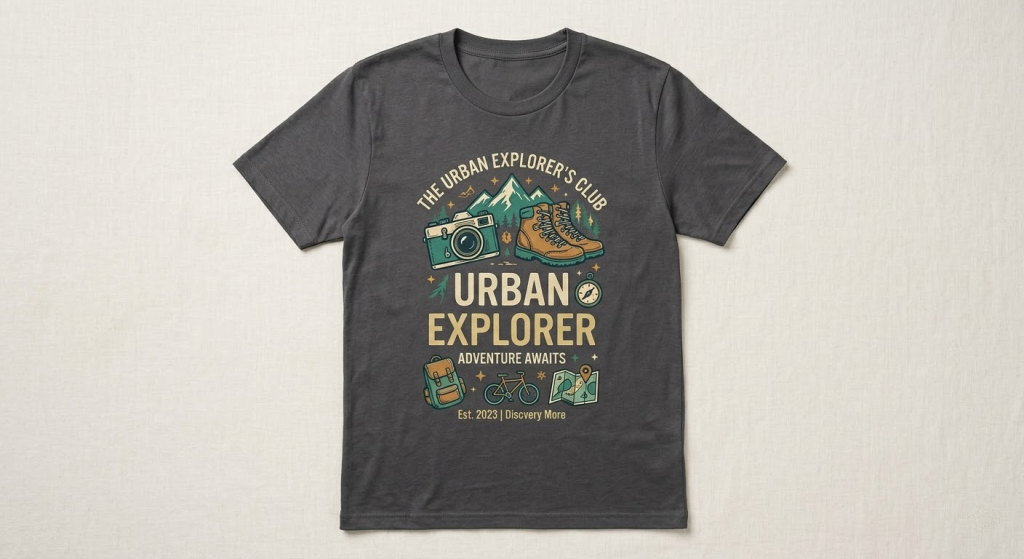
DTF Printing on T-Shirts: Achieving Perfect Results on Cotton and Polyester
The custom apparel market has traditionally been a trade-off. For years, we were forced to choose between the softness of DTG and the durability of screen printing. If a customer brought in 100% polyester sports jerseys, most shops had to decline the job or risk a print that would peel or discolor within weeks.
In 2026, that hierarchy has been turned on its head. DTF (Direct-to-Film) allows us to print on virtually any fabric without the “headache projects” of the past. At Huedrift, we believe this is the ultimate liberation for creatives.
“DTF isn’t just an alternative; it’s the freedom to say ‘Yes’ to every customer who walks through your door.”
Breaking the Fabric Barrier
In the “Cotton Kingdom” era of DTG, 100% polyester was the enemy—the fabric would “eat” the ink, leaving colors washed out.
The Huedrift Lab Test: Last March, we tested a neon green, moisture-wicking jersey (a fabric prone to disintegrating under high heat).
- DTG Control: Faded after only two washes.
- Huedrift DTF: Looked brand new even after 30 heavy-duty wash cycles.
Why DTF Wins the Workflow:
- Zero Substrate Bias: It’s a mechanical bond, not a chemical reaction. The PET film doesn’t care about fabric chemistry.
- No Messy Liquids: Skip the pre-treatment “staining rings” and the stiff vinegar smell on dark garments.
- Mechanical Bonding: Hot melt adhesive powder reaches the fibers that liquid ink can’t.
- Ultimate Versatility: From canvas totes to stretchy nylon windbreakers, the quality remains professional-grade.
Pro Tip: Noticing “ghosting” on sensitive polyester? Drop your temp to 130°C–140°C but increase pressure to 4–5 kg. This stops the fibers from “gassing out” into your white ink.
Vibrant Colors and Sharp Details
DTF colors “pop” because of simple science: the ink sits on a non-porous film instead of being absorbed by porous fabric, guaranteeing 100% color density.
The Huedrift Advantage:
- The Underbase Shield: A thick white ink layer acts as a primer, completely neutralizing the garment’s original color.
- Precision Engineering: PET film has no “grain,” allowing for crisp 2pt fonts and micro-thin hairlines.
- The Mesh Secret: We’ve found that 60–80 mesh adhesive powder provides the best balance of soft “hand-feel” and maximum durability.
- Troubleshooting: If colors look “oily” on the film, your ink limit is too high. Reduce it by 5–10% in your RIP software for instant sharpness.
Material Masterclass: Cotton vs. Polyester
1. Achieving Perfection on 100% Cotton
Cotton is absorptive, which often makes prints feel heavy. With DTF, “less is more.” Because the powder handles the adhesion, you can use a thinner ink layer.
- Case Study: We helped Tony’s Tees transition 500 black hoodies from DTG to DTF. By eliminating pre-treatment drying times, they saved 40% in production time.
2. Mastering Polyester and Synthetics
Polyester is heat-sensitive. Standard cotton settings (165°C) will leave the dreaded “press mark” (a permanent shiny square).
The Huedrift Secret for Polyester:
- Step 1: Pre-press for 3 seconds to remove moisture.
- Step 2: Apply transfer at 135°C for 10 seconds.
- Step 3: Cold Peel. Wait for the film to be completely cold so the adhesive can crystallize into the synthetic fibers.
- Step 4: 5-second “finishing press” with a Teflon sheet for a matte finish.
Summary: The Future of Your Print Shop
In 2026, speed and diversity define success. Whether you are printing high-end streetwear or marathon jerseys, DTF technology ensures you never have to turn away a client.