
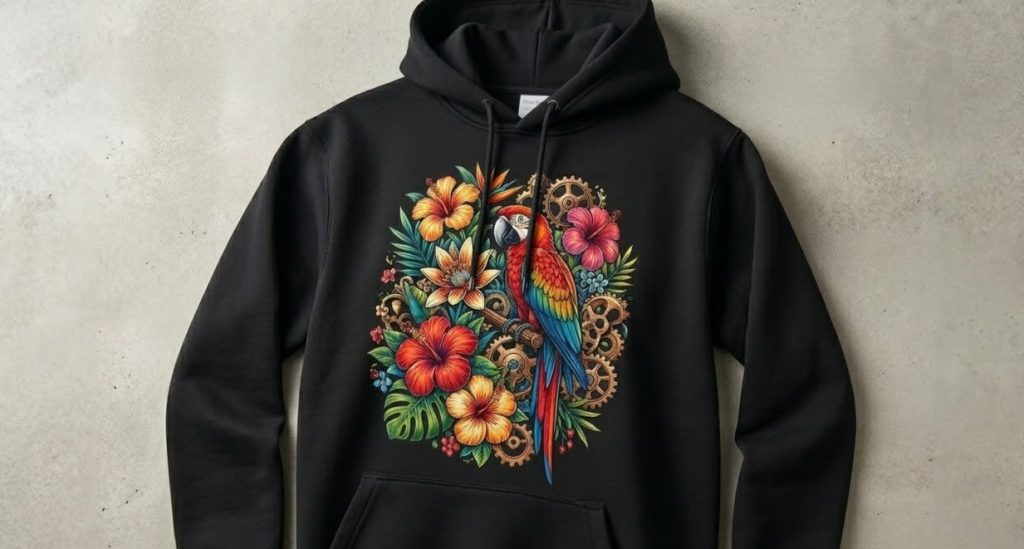
In the fast-paced world of professional garment decoration, the DTF (Direct to Film) definition has evolved from a techy buzzword to a production powerhouse. If you’re like the majority of shop owners I speak with, you’ve realized that while the design looks great, the hardware is what ultimately allows you to make money.
Your DTF printer and DTF oven are the “twin lungs” of your business. I had the opportunity to visit a client last month and witnessed firsthand what happens when these two are out of sync: the printer was producing beautiful films, but the curing process was the bottleneck, leaving the operator standing around. To win in 2026, your hardware must move as one.
THE NEW MODERN DTF DEFINITION: MORE THAN JUST A TRANSFER
It’s time to redefine DTF for 2026. Forget the early days when Direct to Film was merely a finicky alternative to DTG. Today, it is a robust, industrial-strength solution.
It’s no longer just a “patch” you apply to a garment; it’s a complex chemical bond. When you use Huedrift pigmented inks and high-quality TPU powder, you aren’t just printing an image—you are engineering a premium product.
“DTF is no longer just a transfer process. It is a digital bridge. It allows you to go from printing a cotton hoodie to a nylon windbreaker without adjusting a single setting.”
THE HEART OF PRODUCTION: WHAT MAKES A GREAT DTF PRINTER?
The printer is your engine room. For small to mid-sized shops, the goal isn’t just speed—it’s precision and reliability.
The Gold Standard: Epson L1800 & R1390 Printheads
While some talk about industrial heads, the L1800 and R1390 remain the kings of desktop and small-format DTF for a reason. At Huedrift, we have optimized these platforms to deliver:
Crisp Detail: Perfect for intricate logos and fine text that larger industrial heads sometimes struggle to sharpen.
Color Accuracy: Whether it’s a soft neon glow or a deep photographic gradient, these heads provide the professional finish your customers expect.
The Vital White Ink Circulation System
White ink contains titanium dioxide. It’s heavy and loves to settle.Pro Tip: Don’t just rely on the printer’s internal tech. Every morning, before you hit the power button, give your ink tanks a gentle 30-second shake. This ensures the “settling” doesn’t clog your lines, keeping your white base thick and opaque.
THE UNSUNG HERO: WHY THE DTF OVEN IS CRUCIAL
I see many businesses invest their entire budget into a printer and then try to cure the film with a $200 heat press. That is a recipe for disaster. The DTF Oven is what “locks in” the quality.
Beyond the “Hover” Method
Can you cure film by hovering a heat press? Technically, yes. Is it a good idea for a growing brand? No. A Huedrift DTF oven provides a 360-degree heat environment. This is vital for A3+ wide images where a heat press might have “cold spots” at the edges, leading to prints that peel after the first wash.
Mastering the “Orange Peel” Effect
Your goal is to achieve a melted, glossy texture that resembles an orange peel.
The Snap Test: Once cured, the design should feel like a thin, flexible rubber skin.
Troubleshooting: If it feels gritty like sandpaper, your oven temperature is too low. If it’s smoking or turning yellow, you’re burning the adhesive!
SYNERGY: HOW THE PRINTER AND OVEN WORK TOGETHER
The relationship between your Huedrift printer and oven determines your stress levels.
Workflow Efficiency: Our L1800 and R1390 systems are designed to be compact and efficient, making them the perfect “matched pair” for boutique production.
The “Loop” Trick: Ensure there is a slight “sag” or loop in the film as it moves toward the oven. This tension relief prevents the film from being pulled unevenly, protecting your print alignment.
Long-Term Washability: If your ink density and oven temperature are perfectly matched, your prints will withstand 50+ industrial washes. If a print cracks early, don’t blame the printer—check your oven settings!
WHY CHOOSE THE HUEDRIFT ECOSYSTEM?
Zero Pre-treatment: No more messy liquids like DTG.
No Darkrooms: No screens, no emulsions, and no power-washing.
Dark Fabric Freedom: Total dominance over the black cotton t-shirt market.
FREQUENTLY ASKED QUESTIONS (FAQ)
Q: Should I choose the L1800 or the R1390? A: Both are excellent A3+ platforms. The R1390 is often praised for its color handling, while the L1800 is a legendary workhorse with widely available parts. Huedrift optimizes both for maximum DTF performance.
Q: What temperature should my Huedrift oven be? A: Most TPU powders melt beautifully at 150°C – 160°C (approx. 300°F – 320°F) with a dwell time of 2 to 3 minutes, depending on your shop’s humidity.
Q: How often should I clean the system? A: We recommend a weekly check of the oven tray to remove oil residue and a daily nozzle check for the printer to keep the ink flowing perfectly.
CONCLUSION: INVEST IN THE RIGHT ECOSYSTEM
The art of DTF is a commitment to your equipment. The blueprint for success in 2026 is a shop that invests in a reliable, matched hardware ecosystem rather than a “Frankenstein” DIY setup.
You owe it to your brand to use a Huedrift L1800 or R1390 series printer and a fine-tuned oven. Don’t accept anything less than the best when your reputation is on the line.
Ready to see the perfect ecosystem in action? Explore the Huedrift Series today and take your production to the next level.