In today’s world, personalized fashion and entrepreneurship have hit the mainstream, as custom t-shirt prints are trending. Whether you’re a business owner who is launching a wearables brand, designing a limited edition collection, or a DIYer who is creating a one-of-a-kind gift, it’s never been easier to get your designs printed on fabrics.
That said, when it comes to the world of printing – with so many types, basically it can make it complicated to know which is the best method for your project. Each method, whether screen print, heat transfer vinyl, sublimation, Direct to Garment (DTG), and Direct to Film (DTF) all have their pros and cons.
This article will walk you through the five most popular t-shirt printing methods with a comparison of process, pros, cons, and why and how the DTF printer is now a uder’s favorite in 2025.
1. Screen Printing
Screen printing is considered the traditional t-shirt screen printing process. It has been used for several decades and is even now favored by screen printers for producing colorful and long-lasting prints. Screen printing is a process used to create a screen for each color in the design. Then, ink is forced through the mesh of the screen for each color. Once the last color has been printed, the shirt is all then taken through a heat process to set the design.
Pros of Screen Printing
Durable: They can last for multiple washes easily without fading.
Bright opaque colors: Since the ink is on top of the material, these colors will be bright and vivid when used on dark fabrics.
Useful for bulk orders: After you set the screens, you can easily produce hundreds of copies in an economical way of the same shirts.
Cons of Screen Printing
High setup costs: Each color in the design will need a screen and will be expensive for smaller quantities produced.
Limited detail for complex designs: It is more difficult to produce fine gradients or complex images.
Not suitable for single prints: Because it is a process that involves preparation work, screen printing is appropriate for mass production, but not for one-off prints.
Nevertheless, screen printing is perfect for large runs of simple, bold-line designs, but not necessarily in a startup business or a more complicated design.
2. Heat Transfer Vinyl (HTV)
Heat transfer vinyl, or HTV, is another popular choice among crafters and small businesses. It involves cutting designs out of colored vinyl and then applying heat to transfer it to shirts. This will give you a slightly textured design that can have that premium feel if done properly.
Advantages of HTV
Ideal for small orders or a unique tee: No setup fees mean it’s great for personal or unique designs.
Textured finish: Many individuals appreciate the feel of vinyl letters or images.
It’s easy to start with: All you require is a cutting machine and a heat press.
Cons Of HTV
Technically simple design: You’re working with vinyl shapes, so you can’t expect a photographic print quality.
Layering issues: If it is a multi-color design, there will be several layers of vinyl on top of each other.
Durability issues: Ultimately, vinyl will warp or crack over time once washed more than once
Verdict: HTV is easy, inexpensive, and suitable for beginners, but not for high-volume work or detailed designs.
3. Sublimation
Sublimation printing uses heat to transform dye to polyester fabric. The dye becomes gas, which bonds with the shirt, resulting in bright prints and a smooth finish, which looks as if it is a part of the fabric itself.
Pros of Sublimation
Color prints with bright colors: These are ideal for photographic prints.
No texture because it is smooth: The ink is infused into the fabric, so it has a smooth hand.
Very durable: The inks will not fade, peeling, or craze, with washing.
CONS of SUBimation
Limited Fabric Types: It can only be done effectively with polyester-coated fabrics. Cotton shirts would not accept the ink without some treatment.
Color Limitations: Can only be used on white or light color garments.
Specialized Equipment: Requires the sublimation inks, printers, and heat presses.
Final thoughts: “Sublimation is great for vibrant decorations, on polo t-shirts, jerseys, or athletic apparel, but not a great option if you want to decorate using designs you may want to apply to cotton or dark surfaces.”
4. Direct to Garment
DTG is commonly termed “an inkjet printer for clothes.” This technology employs customized printers in which water-based inks are jetted on to the fabric following a procedure much like that used by printers on paper.
Advantages of DTG
Photo Printing: Best suited for designs with details, colors, or gradients.
Natural feel: The ink is absorbed by the fabric, such that it does not have any relief on it.
Ideal for small series or one-off prints: Whether it’s one or one hundred t-shirts, you can easily print it.
CONS OF DTG
Reprinting cost: The cost related to DTG printers can be costly to buy.
Slower process speed: Each tee has to be pre-treated, printed, and dried separately.
Fabric Limitations: Can only be used on 100% cotton fabric. Performance is reduced on synthetic fabric.
Verdict: DTG is fantastic for complex designs and short runs, but it is not so suitable for businesses looking to expand with high volumes.
5. Direct to Film (DTF) Printing: The Game Changer
Finally, we arrive at the technology revolutionizing the customized clothing business: Direct to Film (DTF) Printing.
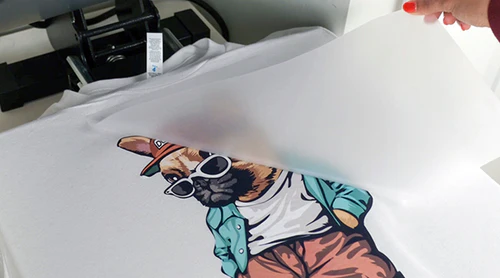
DTF is a process which amalgamates all the good features but nullifies all the negative ones inherent in other procedures. The process is simple: it prints your design on a unique PET film using DTF ink, adding a coat of adhesive powder on top. After curing, you can then heat press it on any fabric: it can work on cotton, polyester, any blend, canvas, denim, and much more.
Why DTF Printing Is Revolutionizing Shirt Printing
Will work with any fabric type – As opposed to DTG or sublimation, DTF doesn’t restrict you to work on any particular type of fabric. From dark to light t-shirts, natural to synthetic materials, to even challenging materials such as nylon or leather.
Colorful and long-lasting designs These designs have bright, intricate, and non-fading, non-peeling, and non-crazed color designs.
Affordable and efficient – It does not require much setup time and has minimal waste. Thus, it is economical for small-scale production, including custom work.
Scalable for businesses: It is easy to prepare transfer templates in advance and then transfer to other business purposes.
User-friendly technology – Today’s DTF printers are small, efficient, and easy to maintain. They can be used by printers with all levels of experience.
Simply put, DTF printing is where affordability, quality, and flexibility meet. It is truly the technique that gives designers the power to produce top-notch designs on any material without necessarily relying on complex and costly setups.

Each method is useful in its own right, but if you’re looking for something with flexibility, color quality, and long-term value, then DTF is definitely on top of this game. No wonder small businesses and big brands alike have turned to DTF technology in 2025.
Whether you’re opening a t-shirt business, looking to expand your manufacturing capacity, or simply looking to give your customers a better quality print job, a DTF printer is one of the best purchases you can make.
If you’re ready to start or improve your t-shirt printing business, take a look at our latest, affordable, efficient, and made for professional t-shirts.
All you need to know about HueDrift Pro DTF Printer: Reliable Partner for Modern T-Shirt Printing
If you’re ready to take your shirt printing to the next level, you will appreciate how this HueDrift Pro DTF Printer gives you everything you need for performance, precision, and reliability. This printer is made for creators and businesses ready to up their custom-printing game. Here is what makes HueDrift Pro unique: Higher 3-in-1 White Ink circulation system — this includes mixing, circulation, and filtration for even ink circulation to prevent clogging and promote up to 50% longer print-head life. Automatic 2-in-1 cleaning system – The daily cleaning process for both print heads will now be done by the printer automatically. Air suction & smooth film-loading system — The air suction is adjustable to avoid curling or slipping of film. Dual Film Modes (Sheet/Roll) – seamlessly switch between single-sheet prints for customized jobs and Rolled prints for massimized productions. Built-in protective film cutter: this will accelerate your work process, as you will be able to cut your film immediately after printing. Versatile Fabric Friendliness: CAPABLE Of PRINTING COLORFUL, DURABLE GRAPHICS on Cotton, Polyester, and Blends. Effective and affordable — it offers outstanding quality and ensures low operating expenses, which makes it perfect for small studios and start-up printers. With both smart features and functional design for producing, the HueDrift Pro DTF Printer is made with the intention of using it to increase your business for creating custom clothing. Ready to see it in action? Visit the HueDrift Pro DTF Printer’s page to see how easy it is to produce a professional shirt print. DTF PRINTING: IT’ S NOT MERELY THE LATEST TREND—IT’ S THE Future of fabric customization.