
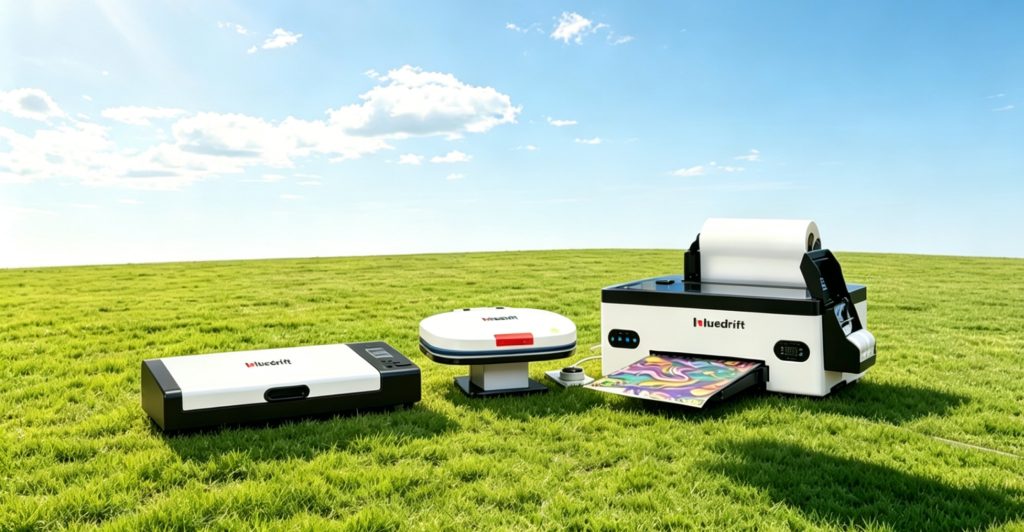
DTF (Direct-to-Film) printing is a process where your design is first printed onto a special transfer film, then heat-pressed onto fabric using adhesive powder. No pretreatment needed — works on cotton, polyester, blends, and more. It's the fastest-growing garment decoration method for small businesses and independent creators in 2025.
01 What Is DTF Printing? A Practical Definition
DTF printing separates the printing and application stages — instead of printing directly onto a garment, you print onto a film first. That film is then transferred to fabric with heat and a hot-melt adhesive powder.
This two-step separation is what makes DTF so versatile. Because the design is prepared on film, it can be applied to virtually any material — no ink reformulation, no pretreatment, no fabric restrictions.
DTF vs. DTG in one sentence: DTG prints ink directly into fabric fibers (best on 100% cotton, requires pretreatment). DTF prints onto film first, then bonds to fabric (works on anything, no pretreatment required).
02 How DTF Printing Works — Step by Step
The full process from digital file to finished garment takes under 15 minutes for a single item.
-
1Print design onto DTF transfer filmA modified inkjet printer lays down CMYK colors plus a white ink base layer — critical for printing on dark fabrics without fading.
-
2Apply hot-melt adhesive powderWhile the ink is still wet, adhesive powder is dusted evenly across the design. Shake off excess at a 45° angle to prevent edge clumping.Mesh: 80–100 recommended
-
3Cure the powder with heatThe film passes through a curing station (or hover-mode heat press) to melt the powder into the ink, forming a stable adhesive layer ready for transfer.120–130°C · 2–3 min
-
4Heat-press onto fabricPlace the film design-side down on your garment and press. Don't rush — pressing too briefly is the leading cause of peeling after washing.160°C · 12–15 sec · Medium pressure
-
5Peel film and finishWait 5–10 seconds, then peel the film while still warm. Peeling cold risks design separation; peeling hot risks smearing. The transfer is now permanent and washfast.
Most common beginner mistake: Pressing for 8–10 seconds instead of the full 12–15 seconds. Always use a timer — this single habit eliminates 90% of peeling issues.
03 Fabrics That Work with DTF Printing
DTF's biggest practical advantage is fabric versatility. Because the design bonds via adhesive rather than absorbing into fibers, it performs on materials that defeat other methods.
Avoid 100% silk. Silk cannot withstand the 160°C heat-press temperature required for full adhesion — designs will not bond correctly and fabric damage is likely.
04 Why DTF Printing Is Popular with Small Businesses
05 Why Choose HueDrift DTF Printers
Once you understand DTF printing, the next decision is which printer won't slow you down or create constant maintenance headaches. HueDrift builds DTF printers for practical, everyday production — from first prints to daily commercial runs.
Engineering Features That Matter
06 Best HueDrift DTF Printers to Buy in 2025
Three models, each matched to a different stage of business. Choose by volume — not by what sounds impressive.
- Compact footprint — fits a standard work desk
- Designed for consistent, stable output without constant calibration
- Affordable entry point — minimizes risk while learning DTF
- Ideal for T-shirts, tote bags, and sample runs
- Faster print speed — handles consistent daily order throughput
- Enhanced feed stability reduces misalignment on longer runs
- Balanced cost-to-output ratio for growing revenue streams
- Step-up from One without full production-level investment
- Built around the proven L1800 engine for consistent color accuracy
- Engineered for stable operation across extended production runs
- Highest throughput in the HueDrift lineup
- Built for users who can't afford downtime
07 Choosing the Right Printer — Quick Match Guide
Answer these questions before buying: How many prints per day? Do you plan to scale? Custom samples or full production?
DTF vs. DTG vs. HTV — Full Comparison
| Feature | DTF Transfer | DTG Printing | Heat Transfer Vinyl |
|---|---|---|---|
| Pretreatment needed | ✓ None | ✗ Dark fabrics | ✓ None |
| Fabric compatibility | Cotton, poly, blends, denim, leather… | Best on 100% cotton only | Most fabrics; avoid high stretch |
| Multi-color designs | ✓ Full color, no extra cost | ✓ Full color | ✗ Each color = extra layer + weeding |
| Setup time per job | ~2 min | ~6 min | ~15–25 min |
| Feel on fabric | Soft, flexible | Very soft (into fibers) | Can feel stiff / rubbery |
| Best batch size | 1–200 units | 200+ units | 1–20 simple designs |
| Small-batch unit cost | Low (~$0.30–$0.80) | Higher (pretreatment) | Low for simple designs |
08 Frequently Asked Questions
DTF stands for Direct-to-Film. The name describes the process: your design is printed directly onto a special transfer film — not onto the garment itself. It is then heat-pressed to fabric using hot-melt adhesive powder.
No. DTF requires zero fabric pretreatment — not even on dark or synthetic fabrics. This saves $0.15–$0.40 per unit and 3–5 minutes of prep time compared to DTG printing.
DTF works on cotton, polyester, cotton-poly blends, denim, canvas, nylon, leather, spandex, and fleece. The one exception: avoid 100% silk — it cannot withstand the 160°C heat-press temperature required.
The HueDrift One is the recommended entry-level model. It is compact, straightforward to operate, and delivers consistent output without overwhelming complexity — ideal for first-time users, hobbyists, and small custom order volume.
✓ Start Your DTF Journey with Confidence
You now have a clear DTF definition, understand how DTF printing works step by step, and know which HueDrift model matches your current business stage.
DTF's combination of fabric versatility, no-pretreatment workflow, and small-batch economics makes it the most accessible professional printing method available in 2025. The HueDrift lineup removes the technical barriers — so you can focus on building your business, not troubleshooting equipment.
Explore HueDrift Printers → Free Setup Guides· Author name "Jordan Mace" is a placeholder — replace with real author + LinkedIn URL for E-E-A-T
· Internal links (/blog/dtf-vs-dtg etc.) are placeholder slugs — update to live URLs
· "50+ wash cycles" claim — attach lab test image or methodology footnote before publishing
· Cost figures ($0.30–$0.80 per unit, $0.15–$0.40 pretreatment) — verify against current consumable pricing
· Add real og:image URL to Open Graph meta tag
· Confirm FAQPage JSON-LD in <head> matches final FAQ text exactly
· "HueDrift Pro" links to /products/ — update to specific product page URLs per model