
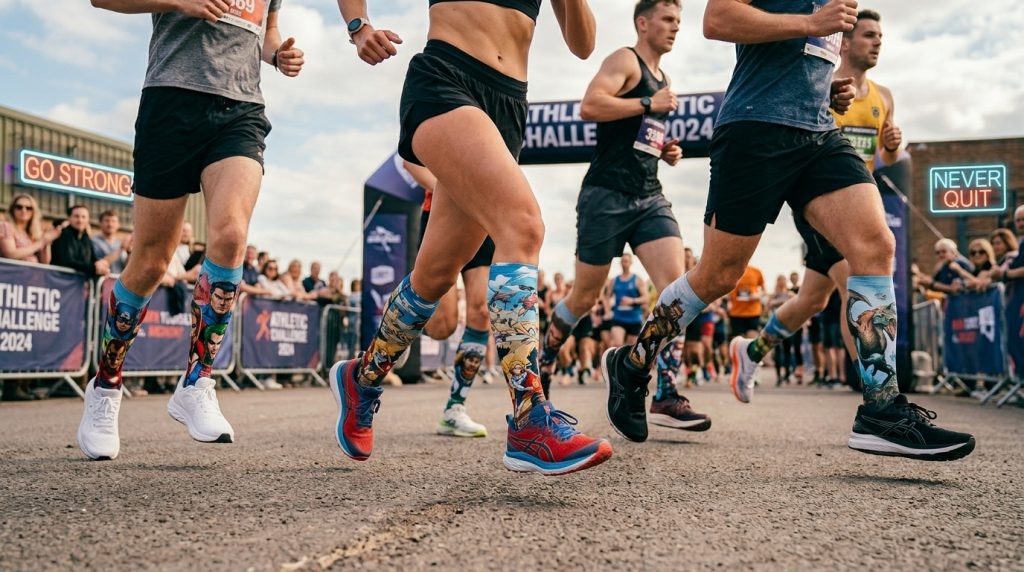
If you've ever flipped a custom sock inside out and noticed the design awkwardly stops halfway around the leg, you've already seen the problem 360 sock printing was built to solve.
In one sentence: 360 sock printing is a method where the sock rotates continuously around its own axis while the print head lays down ink — wrapping your design seamlessly around the entire tube. No gaps. No seams. No blank back side.
That continuous rotation is the whole game. Traditional sock decoration treats a sock like a flat T-shirt — press one side, hope nobody looks at the other. A 360 socks printer treats a sock like what it actually is: a cylinder.
And the result looks like a finished factory product, not a craft project. For DIY beginners, that visual quality gap is what determines whether someone pays $20 a pair — or asks for a discount. One important caveat up front: every 360 socks printer in this guide works only on polyester socks, not cotton.
Polyester Socks Only
Every 360 socks printer covered here uses disperse ink, which only bonds with polyester fibers at high temperature. Cotton, wool, bamboo, and other natural-fiber socks will produce washed-out, faded, or non-adhering prints. Always use blanks that are ≥80% polyester — this is non-negotiable for any DTF-based sock printing system.
Why Traditional
Methods Fall Short
Before going further, let's be honest about the alternatives most beginners try first:
- Screen printing demands minimum orders of 100–500 pairs. Useless for one-off custom gifts.
- DTG (Direct-to-Garment) was designed for cotton T-shirts. On stretchy polyester socks, the ink sits on top of the fibers and tends to crack when stretched without specialized stretch additives.
- Sublimation transfer can only press one flat side at a time. The other half stays blank — or you spend twice as long and still get a visible seam where the two halves meet.
- Heat transfer vinyl (HTV) peels at the edges after a few washes, especially on the high-friction zones around the heel and toe.
The seam problem isn't cosmetic. It's the single biggest reason customers can spot a "homemade" sock from across the room — and the reason they hesitate to pay premium prices for it.
That's why "360°" isn't marketing fluff. It's a real engineering shift that removes the one defect customers actually notice.
360° Wrap vs. DTG vs. Sublimation
Here's how the three methods stack up from a small-studio perspective:
| Factor | 360° Wrap | DTG | Sublimation |
|---|---|---|---|
| Min Order | 1 pair | 1 pair | 1 pair |
| Pre-Treatment | None | Required | None |
| Stretchy Polyester | Excellent | Cracks easily | Flat only |
| Coverage | Full 360° wrap | Front + back, seams | One side only |
| Wash Fastness | Grade 3.5+ | Varies | Strong |
| Cost / Pair | $1.50–$2.00 | $2.00–$3.00 | $1.00–$1.50 |
| Setup Time | ~30 sec | 3–5 min | 1–2 min |
The DIY takeaway: if you're working from a desk in your spare room and want to ship single-pair orders that look professional, 360° wrap printing is the only method built for that exact use case. DTG was designed for shirts. Sublimation was designed for flat goods. Only 360° was built for cylindrical, stretchy garments from the ground up.
How A 360° Socks
Printer Actually Works
Most explanations skip this part because it sounds technical. But understanding the workflow takes about 90 seconds — and once you see it, the value of 360° becomes obvious.
Send Your Design From A Phone
Modern desktop 360 socks printers connect to a mobile app. You upload your artwork — pet photo, family logo, repeating pattern — directly from your phone. No design software, no driver installation.
~30 SECInk Onto DTF Film
The printer lays high-temp disperse ink (CMYK, with optional fluorescent swap) onto a special DTF transfer film. This is the same proven technology powering modern apparel printing.
~1 MINHot-Melt Powder, 180°C / 2 min
Sprinkle hot-melt powder over the wet print, shake off the excess, then cure in the oven at 180°C for 2 minutes. The powder activates and locks the ink to the film.
~3 MINSock Spins. Print Head Stays.
Mount the blank sock on the printer's rotating mandrel. Press start. The sock rotates 360° while the heated transfer head laminates the design seamlessly around the entire tube.
~2 MINPeel, Cool, Inspect
Peel the carrier film. Stretch-test for color stability. Pack and ship. Total time per pair, end-to-end: under 7 minutes.
~1 MINThe reason this works on stretchy polyester — where DTG fails — is the disperse ink. Instead of sitting on top of the fibers, it sublimates into the polyester at 180°C and bonds at the molecular level. Stretch the sock all you want; the color stretches with it.
Why DIY Beginners
Are Switching In 2026
The shift isn't accidental. Three things converged at once — and they all point toward DIY-scale operators winning a market that used to belong only to factories.
1. The Demand Side Exploded
Pet portrait socks, family reunion sets, sports team socks, and corporate gift socks have moved from "niche Etsy curiosity" to mainstream gift category. Buyers expect personalization — and they expect it on a single pair, not a bulk order.
2. The Hardware Barrier Collapsed
Five years ago, a 360° sock decoration line was a six-figure industrial install. Today, desktop-grade 360 socks printers sit in the $5,000–$8,000 range — about the cost of a used car, recoverable in a single month of part-time selling.
3. Single-Pair Orders Convert Better
On Etsy, TikTok Shop, and Instagram, listings for one-of-a-kind custom socks consistently outperform bulk listings. Buyers want their pet, their family, their logo — not a pack of 50 generics.
The market wants single-pair custom socks. Until 360° desktop machines existed, almost nobody could supply them profitably. That gap is the side hustle.
The Side-Hustle
Math, In Stats
Forget vague promises about "passive income." Here's what the math actually looks like, based on real desktop-system specs and current marketplace pricing:
These numbers are conservative. They assume part-time effort, single-pair pricing, and zero scaling. Operators who batch designs, cross-sell on multiple platforms, or land team/event orders typically beat these numbers significantly.
Mistakes That
Kill Your First Month
Most operators who quit don't quit because the technology failed. They quit because of one of these four self-inflicted fouls — all completely avoidable:
Buying Cotton Socks
Disperse ink only bonds with polyester fibers. Cotton or wool socks come out faded and washed-out. Always use ≥80% polyester blends.
Skipping The Stretch Test
If you don't stretch every pair before shipping, you'll find out about cracking after the customer leaves a 1-star review. Stretch-test every single pair.
Underpricing By Habit
Beginners see $0.50 wholesale socks and panic-price at $8 retail. Custom socks compete with gifts, not commodities. $20 is the floor, not the ceiling.
Forgetting Care Instructions
Without "wash cold, inside out" on the tag, customers will toss them in hot wash and blame the print. Print care instructions on every order.
Questions From
The Sidelines
The most common questions DIY beginners ask before they pull the trigger on their first 360 socks printer: