
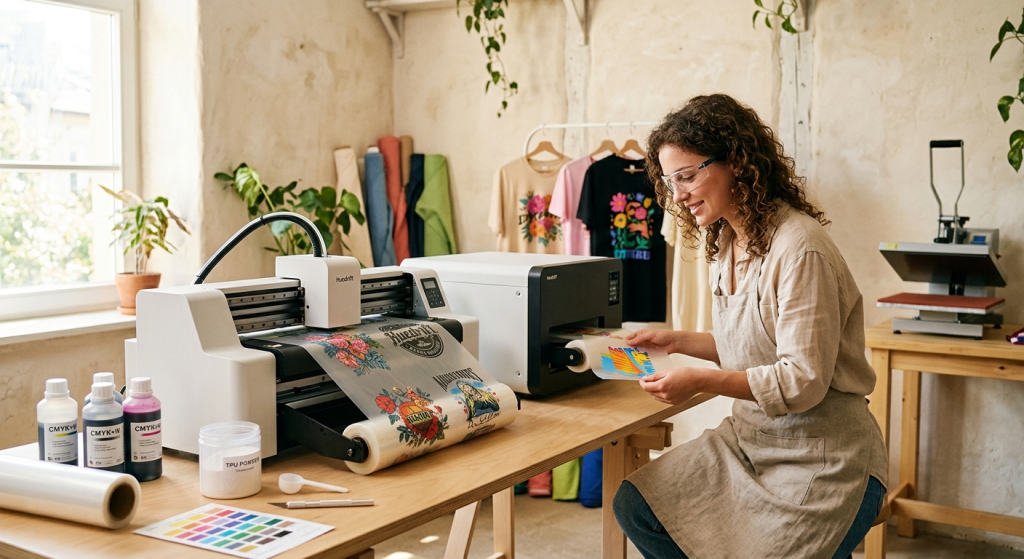
How to Choose the Best DTF Printing Machine for Your Small Business
Cheap modified desktop printers clog constantly. Industrial machines cost a fortune. The sweet spot is finding an affordable, efficient machine matched to your real output needs — and knowing exactly what to look for before you spend a dollar.
Why DTF Works Especially Well for Small Custom Print Shops
Direct-to-film printing removes two of the biggest barriers that held back small apparel decorators for years: minimum order quantities and fabric restrictions. Unlike screen printing, which requires expensive setups per design, DTF lets you produce a single custom piece as profitably as a batch of 50.
The other advantage is material flexibility. DTF transfers adhere to cotton, polyester, nylon, canvas, and blended fabrics — without pre-treatment — and hold sharp detail on both light and dark garments. That means one machine can cover T-shirts, hoodies, tote bags, hats, and sportswear from a single workflow.
For startups and growing studios, this combination of low minimums and broad substrate compatibility makes DTF the most versatile entry point into custom apparel production available today.
The Hardware Specs That Actually Affect Your Work
Cut through supplier marketing and focus on the three specifications that determine real-world performance.
When installing your machine, adjust the capping station height with a standard business card as a feeler gauge. You should be able to slide it out with light resistance only. This seal prevents printhead nozzles from drying overnight — the cause of roughly 90% of morning blockages our technicians see in new installations.
A Note on Printhead Longevity
The Epson i1600 and XP600 are both widely used in commercial DTF machines, but they serve different use cases. The i1600 is a dual-channel head suited to higher-volume continuous printing. The XP600 is common in more compact A3 setups and is easier to source as a replacement part. Whichever your machine uses, confirm that your supplier stocks spares before purchasing.
The True Cost of Ownership: Beyond the Machine Price
The most common financial mistake in this industry is spending the entire equipment budget on the printer itself. A DTF setup is a system, not a single device — and the ancillary costs add up quickly.
- 🖨️ DTF Printer
- 🔥 Curing Oven
- 💨 Fume Extractor
- 🎞️ PET Film Roll
- 🧪 TPU Hot-Melt Powder
- 🎨 DTF Textile Inks
- ⚙️ Replacement Parts (annual)
Environmental Control: The Variable Nobody Budgets For
In our Guangzhou print lab, we ran a dual-head machine continuously for 48 hours under controlled conditions. The finding was unambiguous: maintaining room humidity strictly between 45% and 55% RH completely eliminated ink deflection. Below that range, static builds up on the PET film surface and causes ink to spread outside its intended path — producing faulty transfers that waste both film and ink.
Budget for a hygrometer and a small humidifier or dehumidifier depending on your climate. In dry regions like the US Southwest or arid winter climates, this is not optional — it's the difference between consistent prints and constant rejects.
Also account for ventilation. A curing oven generates fumes that require either outdoor venting or a high-capacity activated carbon filter system. This affects both workspace safety and local compliance in many areas.
DTF vs. Other Decoration Methods: An Honest Comparison
Before committing to DTF, understand where it wins, where it doesn't, and whether it fits your current order mix.
| Factor | DTF | DTG | Dye Sublimation |
|---|---|---|---|
| Dark fabric support | ✓ Yes | ◑ Requires pre-treatment | ✗ Light fabrics only |
| 100% Cotton | ✓ Yes | ✓ Yes | ✗ No (polyester required) |
| Nylon / Mixed fabrics | ✓ Yes | ✗ Poor results | ✗ No |
| Pre-treatment needed | ✓ None | ✗ Required for dark garments | ✓ None |
| Minimum order | ✓ 1 piece | ✓ 1 piece | ✓ 1 piece |
| Wash durability | ✓ 50+ washes | ✓ 50+ washes | ✓ Very high |
| Setup cost | ◑ Mid-range | ✗ High | ◑ Low–mid |
A Real Studio Switch: From Sublimation to DTF
"We were losing sports team orders because our sublimation machine couldn't touch dark nylon jackets or mixed-fabric uniforms. After switching to DTF, we said yes to every fabric combination a team brought us. The printer paid for itself in under three months."
Why Your Supplier Is as Important as Your Machine
A DTF printer is a precision system with components that will eventually need replacement — printheads, dampers, capping stations, wiper blades. The supplier you choose determines how quickly you recover when something breaks and how well you learn to run the machine correctly from day one.
When evaluating any supplier, ask three specific questions: (1) Where are your spare parts warehoused and what is typical delivery time to my location? (2) Do you provide a local contact or must I route all support through overseas channels? (3) What is your replacement printhead turnaround time?
Frequently Asked Questions
-
Perform a basic nozzle check and head cleaning every day — even on days with no active print jobs. White ink settles within hours, and skipping daily maintenance is the single most common cause of printhead failure. On high-volume days, run a check at both the start and end of your session.
-
Yes, but ventilation is non-negotiable. The curing oven generates fumes that must be vented outdoors or captured with a heavy-duty activated carbon filter. Check local zoning rules for home-based manufacturing in your area before purchasing equipment, as requirements vary by municipality.
-
A properly cured transfer using quality hot-melt TPU powder and textile-grade DTF inks reliably withstands 50+ commercial laundry cycles without cracking or peeling. Wash durability depends heavily on curing temperature and dwell time — under-cured prints fail significantly earlier.
-
Target 45–55% relative humidity. Below 45%, static electricity accumulates on PET film and causes ink deflection, resulting in blurry or misaligned prints. Above 60%, ink dry time increases and powder adhesion can become inconsistent. A basic hygrometer costs under $15 and removes all guesswork.
-
A3 machines (30 cm / 12 in print width) handle full chest prints, sleeves, and standard apparel graphics — everything a small to mid-volume studio needs. A2 and wider roll-feed machines (60 cm+) are designed for continuous high-volume production and carry significantly higher hardware and consumable costs. Start with A3 unless you already have confirmed order volume that justifies the upgrade.
Ready to Find the Right Machine?
Explore our optimized, low-maintenance DTF printing setups — engineered for small studios and backed by local US and EU parts support.
Explore Huedrift One & Pro Series →