
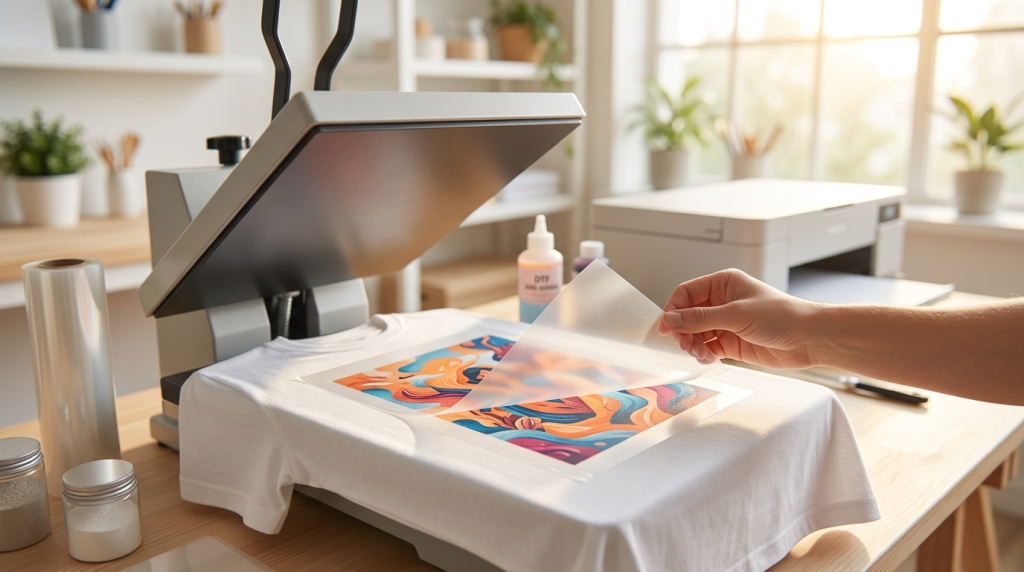
What Is DTF Printing? A Complete Explanation
Direct to Film (DTF) is a digital printing process in which designs are printed onto a PET film, coated with hot-melt adhesive powder, and heat-pressed onto fabric. It works on virtually any textile — making it one of the most versatile transfer methods available today.
What Does DTF Mean?
DTF stands for Direct to Film. Unlike older iron-on or screen-based transfers, your design travels from a computer directly onto a transparent PET (polyethylene terephthalate) film — and only then gets transferred to garment. The film is the intermediary that makes the whole process so flexible.
This distinction matters: in DTG (Direct to Garment) printing, ink is sprayed directly onto a fabric surface. In DTF, the ink lands on film first, which means the type or weave of the fabric is largely irrelevant to print quality.
In short: DTF lets you print any full-color design onto almost any fabric — synthetic, natural, or blended — without screens, without pre-treatment, and without minimum order quantities.
Four Core Components
DTF printing requires four specific materials. Standard inkjet printers and inks will not work — each component is purpose-built for textile transfer.
DTF Printer
A specialized inkjet printer with dedicated ink channels that can handle white ink — including a circulation system to prevent clogging.
Pigment Inks
A textile-specific ink set including CMYK colors plus white. White ink creates the opaque base layer that makes colors pop on dark fabrics.
PET Film
A chemically coated plastic sheet. Available as hot-peel (transfer while warm) or cold-peel (wait until fully cooled) depending on the application.
TPU Powder
A thermoplastic polyurethane adhesive powder that bonds the cured ink to fabric fibers when heat is applied. Particle size affects hand-feel and durability.
Note: a standard desktop inkjet printer cannot perform DTF — it lacks the white ink channel, the ink recirculation system, and the output profile required for textile pigments.
DTF Print Workflow
The process moves through four stages, each dependent on the last. Skipping or rushing any step is the most common source of quality issues.
Print onto PET film
The design is printed in reverse (mirrored) onto the PET film. Color inks print first to form the design, followed immediately by a white ink layer that creates the opaque backing. This order is important: white on top of color, not underneath.
Apply TPU powder
While the ink is still wet, TPU hot-melt powder is spread evenly across the printed surface. The excess is shaken off.
Cure in oven
The film passes through a curing oven (typically a conveyor or DTF curing unit) at around 160–170°C. The TPU powder melts and bonds uniformly with the ink, forming a solid, slightly textured adhesive layer.
Heat press to garment
The cured film is placed ink-side-down on the garment and pressed at the recommended temperature and pressure (commonly 150–165°C for 10–15 seconds). After pressing, the PET film is peeled away — hot or cold depending on your film type — leaving the design bonded to the fabric.
Key Advantages for Apparel Businesses
1. Works on Almost Any Fabric
DTF transfers bond to cotton, polyester, nylon, canvas, denim, fleece, and most fabric blends. This is a meaningful advantage over DTG, which performs best on 100% cotton and struggles on synthetics, and over sublimation, which is limited to high-polyester content only.
Printers working with performance sportswear, nylon shell jackets, or mixed-fiber hoodies consistently report that DTF is the only process that delivers reliable, vibrant results across all of them without changing workflows.
2. Strong Wash Durability
When applied at correct temperature and pressure, DTF prints form a tight mechanical bond with fabric fibers. Well-applied prints resist cracking, peeling, and color loss through repeated machine washing. The TPU adhesive also gives the print some flexibility, so it moves with stretchy or knit fabrics without fracturing.
"We print branded uniforms for a local youth soccer league — the kits get washed after every match. After a full season of use, the numbers and logos on DTF transfers still looked sharp. We haven't gone back to cut vinyl."Print shop owner, Midwest US
That said, print longevity depends heavily on correct application settings. Prints applied at too low a temperature or insufficient dwell time will peel prematurely — this is an operator error, not a material failure.
3. Economical at Any Order Size
Because DTF requires no screens, no color separation setup, and no minimum run to justify costs, it scales in both directions. A single custom t-shirt costs the same per-unit effort as a run of 500. This makes it particularly valuable for on-demand or small-batch production.
"Moving to DTF let us offer a true one-piece minimum. We started getting orders from independent artists who needed 10–20 shirts for a tour or a pop-up — customers we couldn't serve economically before."Custom apparel business owner, Portland OR
For large orders, DTF gang-printing (arranging many designs on a single film sheet) brings the per-transfer cost down significantly. Some shops now produce pre-printed transfer sheets in common sizes and sell them wholesale to heat-press operators who don't own a printer.
DTF vs. Other Print Methods
No single method is best for every job. Here is how DTF compares across the most common decision factors:
| Factor | DTF | DTG | Screen Printing |
|---|---|---|---|
| Fabric compatibility | Any fabric | Best on 100% cotton | Most fabrics |
| Minimum order | 1 piece | 1 piece | Usually 24–48+ |
| Setup cost | None | Minimal | Per-color screen fees |
| Pre-treatment needed | No | Yes (dark garments) | No |
| Print hand-feel | Slightly raised; flexible | Soft, barely perceptible | Varies by ink type |
| Best for | Full-color, mixed fabrics, small runs | Soft prints on cotton, photo-realistic designs | High-volume, spot-color orders |
The choice between DTF and DTG often comes down to fabric type and desired hand-feel. For blended or synthetic fabrics, DTF is the clearer choice. For soft, breathable prints on 100% cotton in large volumes, DTG may edge ahead on feel. Screen printing remains the most cost-efficient option when running thousands of pieces with a limited color count.