
Print on Demand (POD) vs. Buying a Sock Printer: Which Is More Profitable?
You don't need to commit thousands upfront to start a custom sock business. Here's the real cost math behind POD and owning a sock printer ... and when each one actually pays off.
You've realized that custom socks is the industry to join. You know your designs. But you are facing the single decision that stands between you and success: do you print using Print on Demand (POD), or buy your own sock printer? And if you decide to buy one, desktop or industrial?
Here's how the answer looks from my side: for the vast majority of newbies, it's better to start with POD, and only after reaching certain sales volumes does it make sense to buy a printer.
Three options, pick which one is yours
Choosing the wrong option doesn't just waste your time. It wastes money. Before making any calculations, first identify which option suits your needs:
- POD (printing on demand): You design, and a POD provider (Printful or Printify, for example) prints and ships only after a customer places an order. You don't have to buy equipment or stock products. Suitable for checking the viability of your idea.
- Buy a desktop sock printer: Small quantities, many designs, and custom print. Requires a few thousand dollars to start. Suitable for business owners who want to manage their own production and quality.
- Buy an industrial socks machine: Large quantities, lots of printing, the same model. Tens of thousands of dollars required to buy and set up the production.
Most of those who want to get into this should start with the first option. The reason lies in the cost per pair and the initial investment. Let's go through them one by one.
POD: fastest to start, but costly per pair
One of the strongest points about POD is that there is a near-zero barrier to entry. One of its main drawbacks is the cost of production per pair.
The main advantages:
- Zero barrier: no need to purchase a machine. List the socks and start selling right away.
- Zero inventory: no stock to deal with, no need to guess wrong on sizes.
- Low risk: try out a hundred different designs before you settle down.
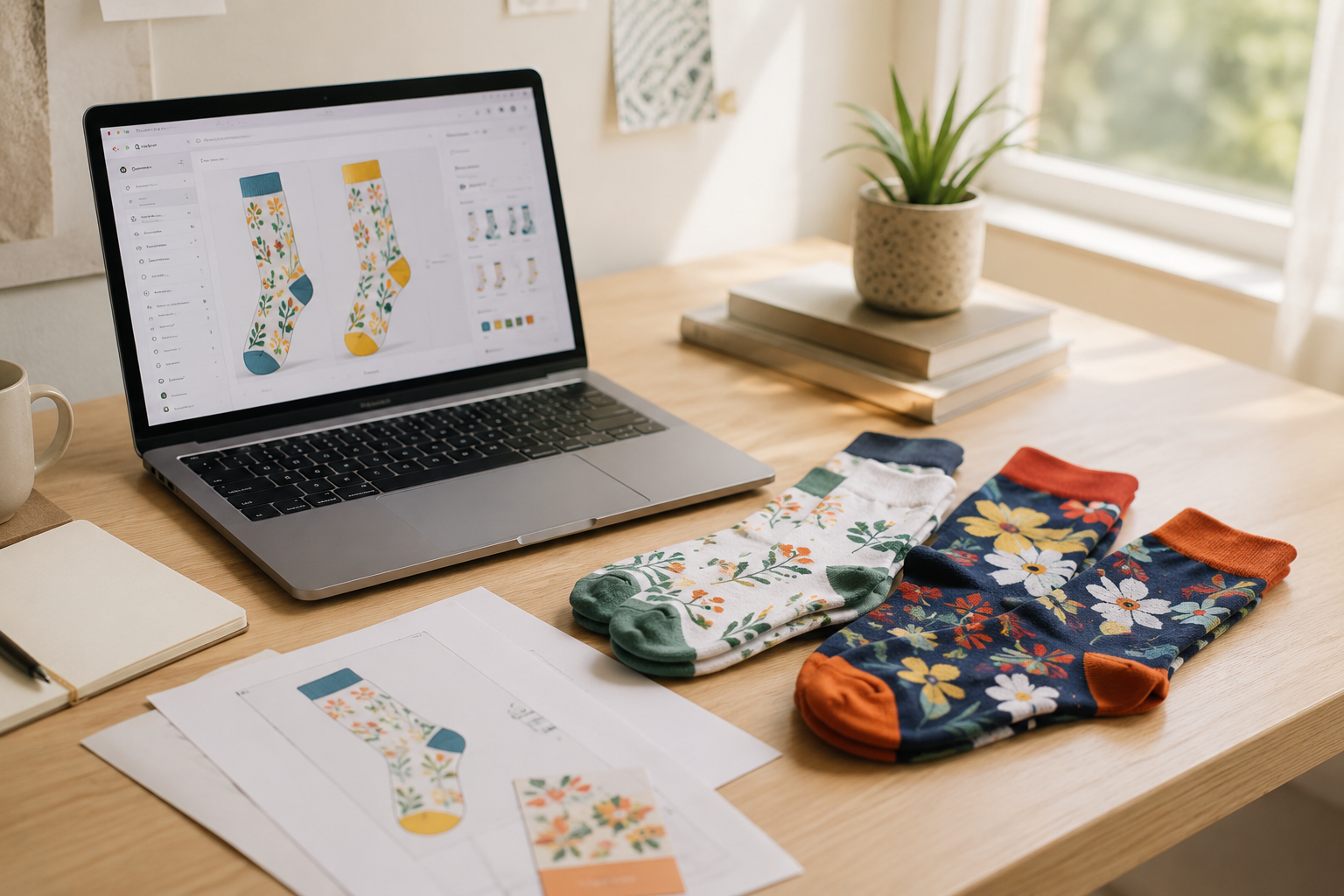
However, the drawbacks of the business model are quite obvious as well:
- The initial price is not cheap. Printful's sublimated socks go for around $10.39 per pair, while embroidered ones cost even more.
- The true landed cost is actually way higher. As one Etsy seller from Cyprus calculated herself, when she included all the fees, shipping, and taxes, she spent more than $20 on each pair of socks. After adding the Etsy fees, she came close to $25 per pair. Her honest question was: how can you sell such socks at a profit?
- It requires time to get to scale. POD sellers need around 165 days to reach the first $1,000 in revenue.
- Margins are slim. The POD service provider keeps most of the manufacturing and logistical margin for itself.
So POD is "easy to start, but expensive per pair." But how cheap would printing the socks yourself really be?
Print it yourself: around $1-2 per pair
If you print at home, the actual cost per pair is simply materials, and it's lower than you think. Here's the calculation:
- Blank polyester socks: around $0.6-1.5 per pair. That's the actual retail price for 100% polyester blanks on Amazon (a 6-pack works out to $0.64 each, a 20-pack to $0.85).
- Disperse ink: around $0.05-0.20 per pair, depending on design size and coverage.
- Electricity and curing losses: around $0.05-0.10 per pair.
Total cost to print your own socks: roughly $1-2 per pair.
Compare that to POD: $10+ per pair vs. $1-2 per pair. The difference is $8-10 for the same pair of socks. This is why buying a printer can make economic sense in the first place. However, the printer costs money upfront. How many pairs would you need to print to cover that?
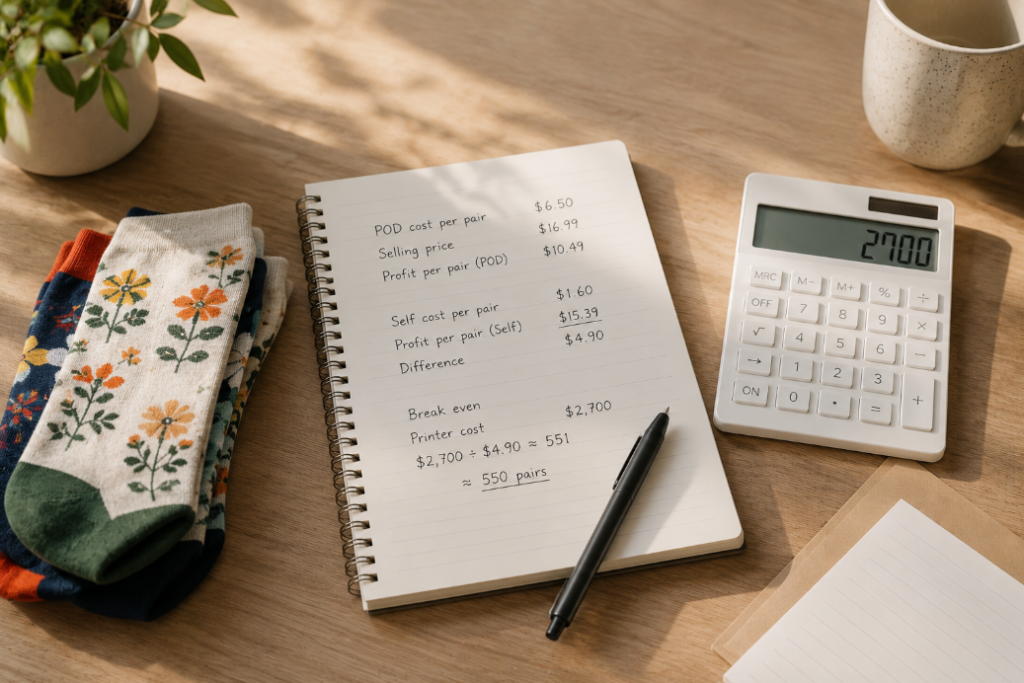
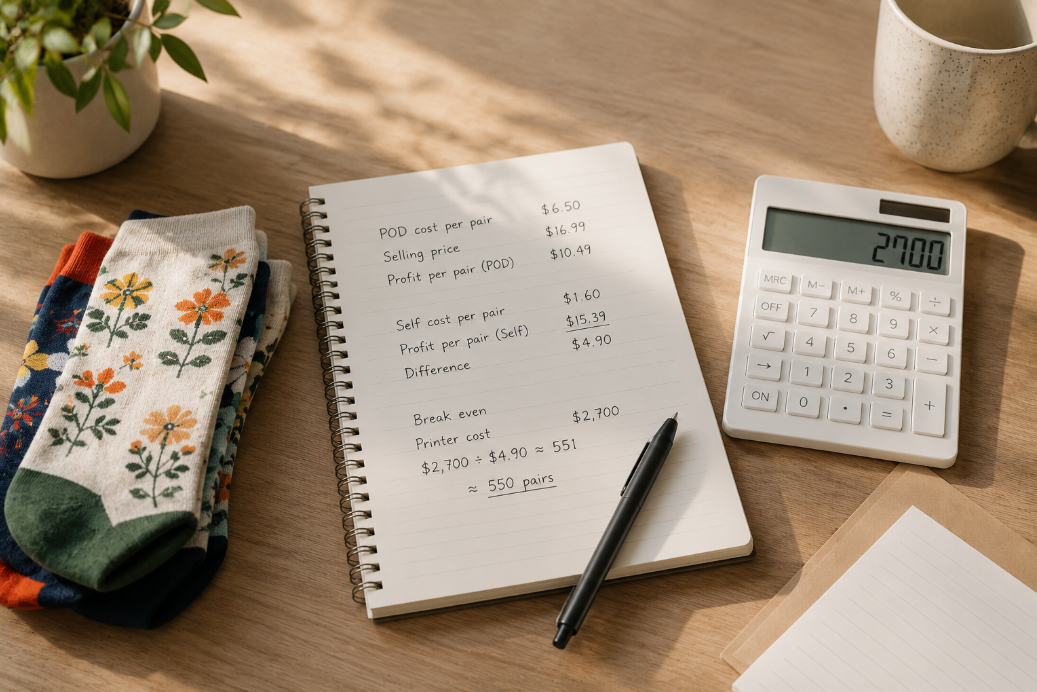
Breakeven: around 550 pairs
The calculation is fairly simple: the cost of the machine divided by savings per pair equals the pairs you need to print to break even.
Plugging in real numbers:
- The cost of a decent desktop sock printer is around $5,000 (a reasonable price for such a device).
- You save about $9-11 per pair printing yourself instead of using POD ($10-13 with POD vs. $1-2 in-house).
- $5,000 ÷ $9 saved per pair ≈ about 550 pairs.
To put it another way, the printer starts paying for itself once you have printed around 550 pairs of socks. From then on, each pair costs you $9-$11 less than POD.
Of course, this is only the approximate breakeven point. Electricity, your labor, and promotion aren't taken into account, so this is not your net profit ... it's simply the time you need to get the cost of the machine back. But it gives you the one figure that counts: order volume is the deciding factor in whether to buy a printer. Low volume? Stick with POD. High volume? Buying gets cheaper with each pair you print.
Lessons learned the hard way
As the calculations show, it's easy to make an impulsive decision based on numbers alone. Before you spend any money, let me share some experiences of people who already went through all of this.
One: she got fooled by the POD sticker price. The seller from Cyprus is the example. A pair that was offered at $10 on a POD site seemed cheap, but when she actually ordered a sample, it ended up costing her $20-25 in total once shipping, taxes, and platform fees were included. The takeaway: don't read the POD sticker price. Calculate what a single pair would actually cost you in hand.
Two: he had one hit and gambled the farm on production. This was shared by a tote bag maker. His first design happened to be so popular that he placed a huge bulk order and even bought a heat press to produce future designs on his own. No one liked his new designs. He ended up with two boxes full of unsold bags and became so demotivated that he stopped creating altogether. The same applies to socks: just because one design sells well doesn't mean another one created by you will sell too.
Three: an honest art-print seller did the math. He began by printing himself and then went back to outsourcing, because the cost of ink ate up his margins. His sober analysis was that most of the savings from self-printing is in shipping. If a local printer is willing to sell him a print at $1-2 while he himself can print it at $0.40, the gap isn't as attractive as it seems. Same for socks: the savings you get by in-house printing are likely less than the unit gap suggests. Without the volume, those savings won't offset the machine.
All three examples boil down to the same idea: the real danger in this industry isn't failure to turn a profit, but making commitments too soon. Make the smallest commitment necessary to validate demand, and only then ask yourself how to cut your cost structure. With that in mind, if you do reach that stage, should you go desktop or industrial?
You're purchasing. Desktop or industrial?
The point is this: personalized small batches → desktop. Large-scale runs of the same design → industrial. They aren't only different in price; they are designed for completely different business models.
- Desktop machine ($3,000-7,000): around 30 pairs per hour, one pair at a time if you want, easy to swap designs, compact, can be operated by one person. Built for small batches, multiple designs, and on-demand production.
- Industrial machine (a full line runs $10,000-50,000): up to 45-80 pairs per hour or more, but the unit alone is about 3 meters long and comes with a large oven. If you produce cotton socks, you'll also need a steamer and a washer-dryer line. Someone has to take care of the machine.
If you're doing personalized custom socks, the desktop printer is the way to go. And here's one surprising thing that many beginners miss.
Don't get caught in the "more output is better" trap
When it comes to personalized products, higher output isn't an asset. It's often a waste.
Why? Because personalized custom socks are naturally low-volume, with many different designs printed to order. Each customer wants their own thing: some want their dog, others want their kids' faces. You won't be printing ten thousand pairs of the same socks.
So:
- An industrial printer's 45-80 pairs per hour is completely useless on scattered, varied orders. You've paid for capacity you'll never need.
- Switching costs on an industrial machine are high. On varied personalized orders, it actually takes more time and effort.
- The flexibility of a desktop printer is exactly what's needed in this case.
For a small budget and personalized custom socks, a desktop printer isn't "a smaller industrial machine you settle for." It's actually more suitable. With that, the situation becomes clear.
Questions you might still have
The whole picture should be clear by now. Before making any moves, there may still be a few details to address. Quick answers:
POD or printing yourself, which margin is higher?
Printing yourself. You skip the provider's cut, dropping per-pair cost from $10+ to $1-2. The catch is your volume has to justify the equipment.
How soon will the machine pay off?
It's measured in pairs, not months. Roughly 550 pairs for a $5,000 desktop machine. Every pair after that adds to your savings.
Just starting out. POD or buy a machine?
For virtually everyone, start with POD. Zero money invested, zero risk. It lets you figure out which designs actually sell. When sales are regular, revisit buying.
But what if I buy the machine and no orders follow?
This is exactly why buying should come after POD. A machine is a sunk cost. No orders means it sits there burning your money. POD lets you avoid that.
Can I use POD and a machine together?
Sure, and it's quite common. Use POD for new designs and long-tail products. Run your best-sellers in-house to save on cost. Two legs, stronger stance.
So how do you move on from here
Now that everything's been calculated, the path forward gets clearer. It depends on where you are right now.
- Still testing, sales aren't steady yet? Stick to POD. The best way to minimize risk and learn what customers actually want. This is the safest route for most people.
- Sales already regular and you want margins to grow? Then it's time to buy a machine. The cost advantage of a desktop printer starts kicking in, pair by pair.
That's the path most people walk: use POD to validate demand, and once orders are consistent, get a desktop printer to cut costs. The moment you decide it's time to "print my own," the next question is which printer and which printing method ... and that's the subject of another article.
If you've already reached the stage of steady orders and you're ready to print on your own, here's what a 360° direct sock printer looks like in action.
Curious what a real 360° sock printer looks like in action?
Take a look at HueDrift's sock printer and oven setup to see how it runs and what it can make.
View the sock printer →