
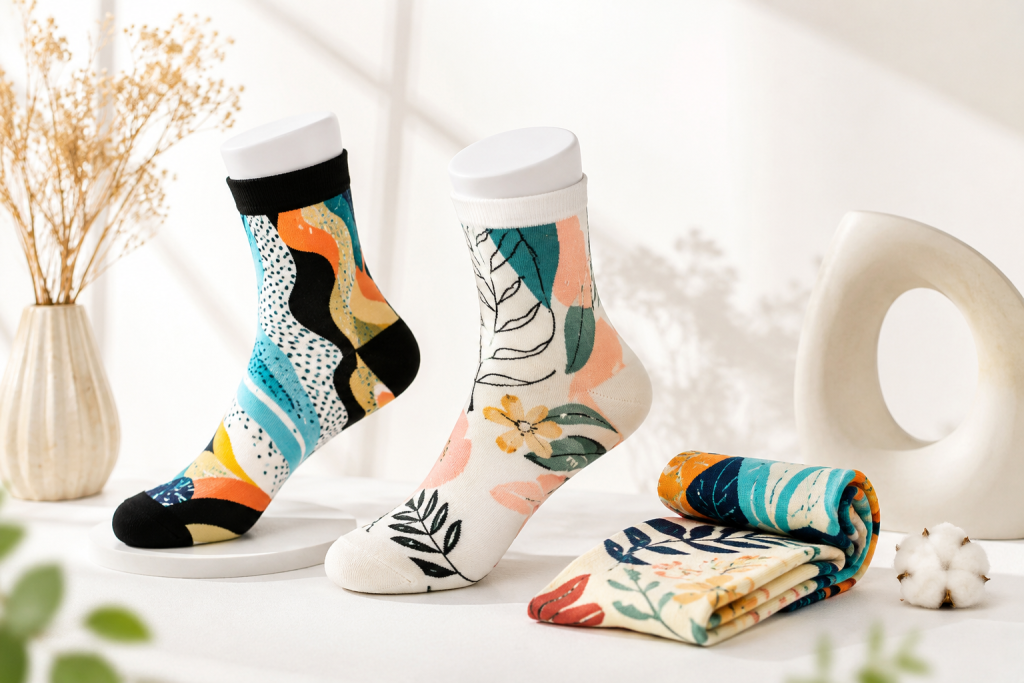
Why Your DTF and DTG Printer Can't Print Socks (And What Actually Works)
Your machine isn't broken, and you didn't do anything wrong. A printer built for flat garments just can't print all the way around a sock. Here's where DTF stops and what to use instead.
Maybe you already own a DTF printer. T-shirts come out great, so you said yes to a sock order ... then hit a wall on a full, wrapped design. Or maybe you're new, you've seen DTF everywhere, and you're asking the obvious question: can a DTF printer handle socks?
Either way, you're really asking one thing. What can DTF do on socks, where does it stop, and when do you need a real sock printer instead?
Here's the bottom line:
DTF and DTG are built to print on flat surfaces. They can put a small graphic on one side of a sock, but they can't print a design all the way around it. It's how the equipment is built, not how you run it. Below, I'll explain why, then show you what does the full wrap.
Can a DTF printer print socks? Yes, but only so far
Let's be fair to DTF. It can print on socks. Some shops even sell sock-specific DTF transfers made for exactly this.
Here's the standard method. First you slide the sock onto a board or a card jig, stretch it out to its worn shape, and pull it tight so it forms a flat, firm surface. Only then can you heat-press it. In other words, you have to force a 3D sock into a flat plane before DTF can touch it. That step alone shows the root problem: it can only work on the one face you flattened.
So DTF is great for a logo or a small graphic on one side. To be fair, a good transfer, pressed correctly, will stretch and survive dozens of washes in that kind of small, low-stretch spot. The transfer sellers aren't wrong about that.
But the moment you want to cover the whole sock, it has two limits you can't design around:
- It can't print all the way around. A flat press platen can't reach the curved sides of a tube, so a design that goes around the whole sock is off the table.
- The design doesn't stretch with the sock. A DTF transfer is a glue layer on the surface. It flexes a little, but it isn't elastic. The heel and toe stretch the most, and a big, solid, full-coverage print is the stiffest kind. Put a stiff, large print on a high-stretch zone, and that's exactly where it cracks.
In short, DTF's comfort zone is a small graphic on a low-stretch spot. The more you push toward a large, full-coverage design on high-stretch zones, the higher the risk. So the real question is this: why would you need a full wrap at all?
The problem is, the market wants the full wrap
Think about the orders you actually get. A customer sends a photo of their dog and asks if you can cover the whole sock with it. A team wants a pattern that wraps around, not a small logo on the side.
That's where custom socks are heading. Full-coverage photo designs are popular right now, and pet photos especially. Phones make it easy to snap, share, and print an image, so people expect it on socks too.
The market is growing too, worth around 1.37 billion dollars globally and climbing each year. Rising demand means there's real business here, and a lot of that demand points at the kind of full, wrapped design DTF can't reach.
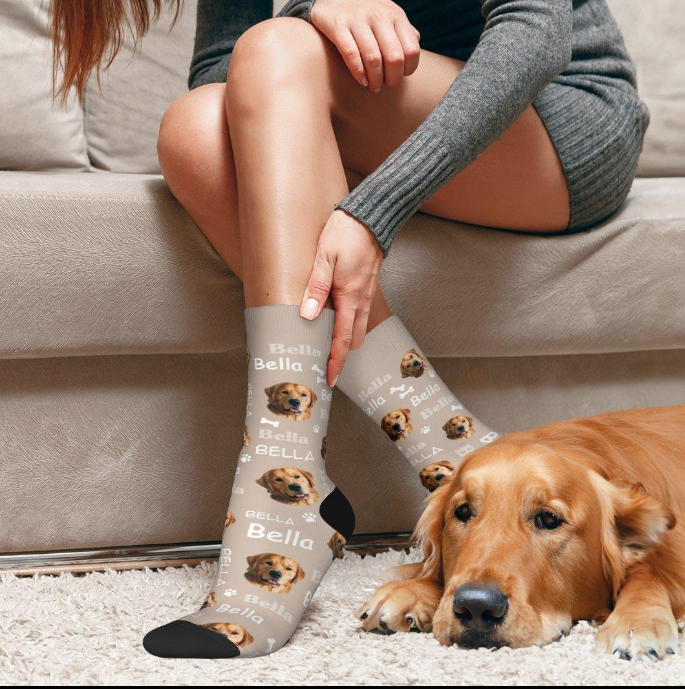
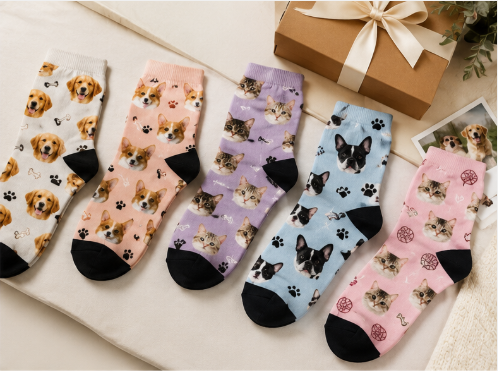
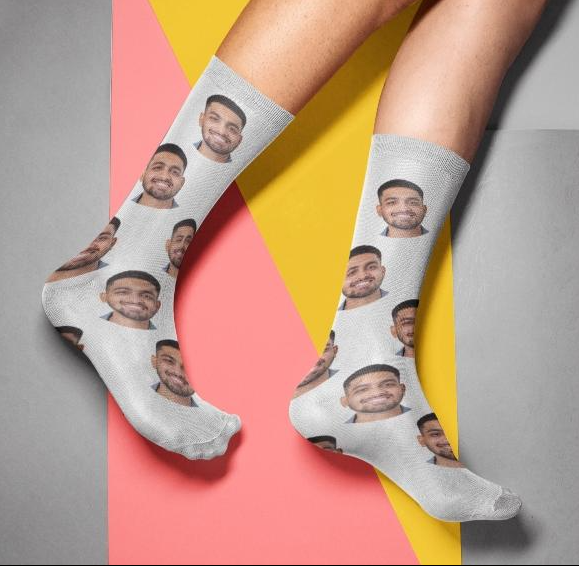
So when a customer wants their dog wrapped around the whole sock ... DTF leaves you stuck. You need a different tool.
The 3 ways to print socks (and which one wraps the whole sock)
There are three methods people call "sock printing," and they're not the same thing. Here's how they compare:
| Method | How it works | Full wrap? | Fabric | Main problem |
|---|---|---|---|---|
| DTF transfer | Print on film, heat-press onto the fabric | No, one side only | Cotton, polyester, and blends | Cracks on high-stretch zones, no full wrap |
| Sublimation transfer paper | Print on paper, wrap the sock, heat-press at ~220C | Barely, leaves white seam lines | High-polyester only | Seam lines, misalignment, no pure cotton |
| 360 direct printing | Ink sprayed onto a sock on a spinning roller, cured in an oven at ~160C | Yes, fully seamless | Depends on the material | Process varies a lot by material |
In plain terms, only one of them does a true, seamless full wrap:
- DTF transfer: great for a small graphic on one face, but no full wrap, and it cracks on high-stretch zones.
- Sublimation transfer paper: works on polyester, but wrapping paper around a tube tends to leave white seam lines, and it won't print pure cotton.
- 360 direct printing: the one method that wraps a design around the whole sock with no seam line.
If you want a full, wrap-around sock in small batches, a 360 sock printer is the answer. So what is it?
What a 360 sock printer actually is
At its core, it's a rotating direct-print system. The sock goes onto a cylinder roller. The roller spins, the print head moves across the top, and the ink wraps around the full circumference.
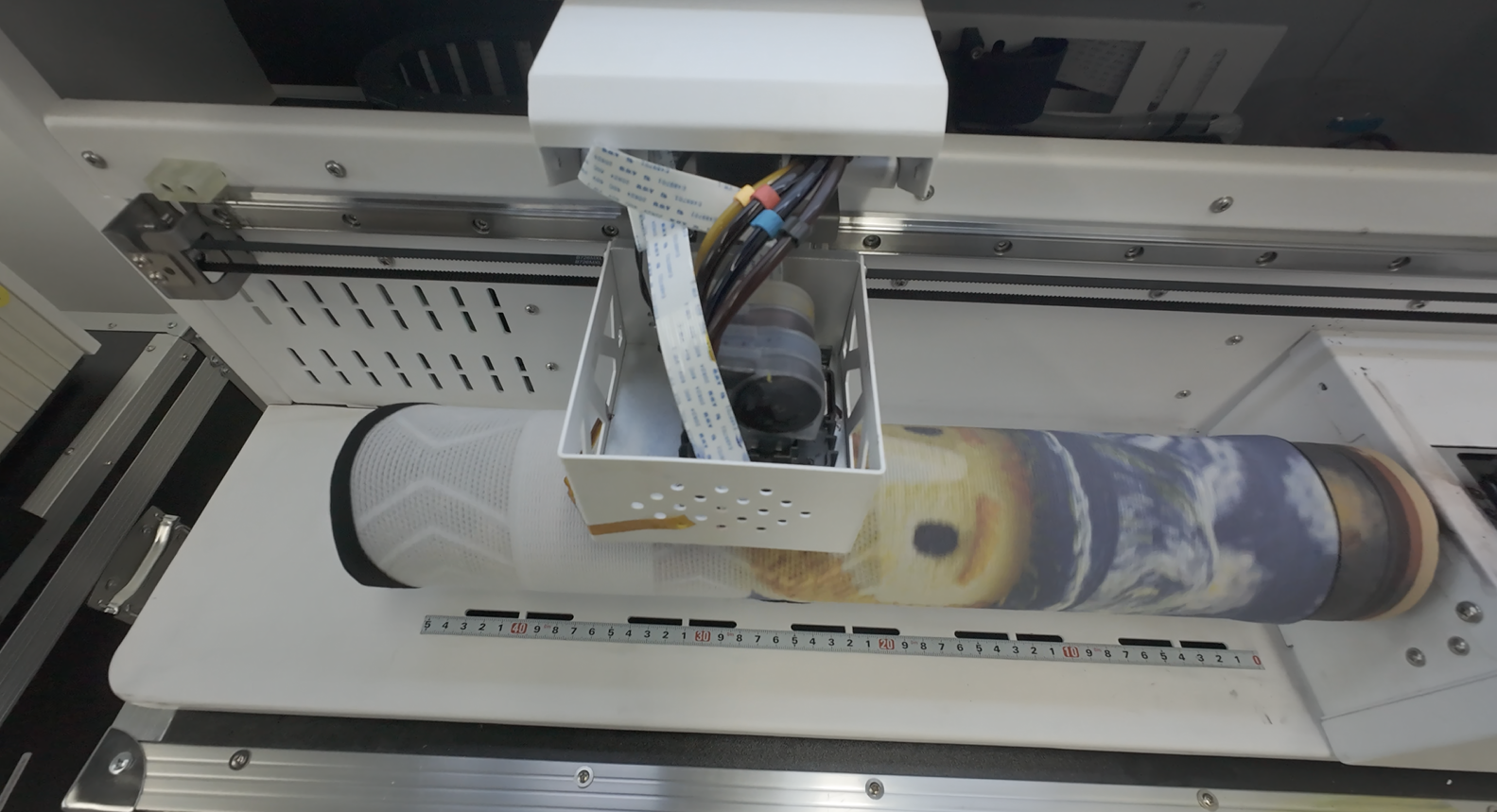
Picture a small rotisserie, except what's turning is a sock, and the head is coloring it pass by pass. Because the roller turns a full circle, the design wraps all the way around with no seam line.
That's the key difference from transfer methods. People often describe it as 180 degrees vs. 360 degrees:
- A transfer can't cleanly close the full circle. Whether it's DTF or sublimation paper, the flat press leaves seam lines on the sides, and the design tends to break or misalign where the two edges meet.
- 360 direct printing is a true full circle. It runs continuous from cuff to toe with no break at the sides, which is the full-coverage look customers are asking for.
Here's a bonus. The same machine isn't limited to socks. With the right roller, it also prints:
- Cooling arm sleeves and sports arm guards
- Sweatbands
These are all tubular fabrics, and they work the same way socks do. One machine can cover more of your orders, and your investment goes further.
But before you picture the profits, you need to know a few things about actually making the socks.
Buying the machine is only the start
A printer alone doesn't finish a sock. Straight off the printer, the ink is still sitting on the surface, and the color isn't set. The sock has to be cured, usually in an oven, before it's done.
How many steps and machines you need depends on the material. This is the part most people skip, and it's the one that decides your real setup cost.
Polyester socks are the easy path:
- Two machines only: a printer and an oven.
- You print, then cure. That's it. No pretreatment, and no washing.
Cotton, nylon, and wool are a lot more work:
- The ink won't set on natural fibers the simple way, so the flow becomes coat, dry, print, steam, wash, and dry again.
- On top of the printer and oven, you need a steamer, a washer, and a spin dryer.
This is why most custom socks you see are polyester. It isn't that polyester is better. It's that the process is short and cheap, which is perfect for small batches.
If you want to keep it simple, polyester is the path of least resistance. Once you know which machines and steps you need, the next thing you'll want to know is simple: will the print hold up?
Will the print survive, and will it sell
Customers judge printed socks on three things: how sharp the design is, how it feels, and whether it fades. All three come down to the method, and all three decide whether people order again.
Detail and color:
- As we said, customers want photo-quality, personalized, full-coverage designs. That needs a method that prints sharp detail and rich color.
- 360 direct printing uses disperse ink, the same dye family as sublimation. It handles photo-quality prints, smooth gradients, and vivid color, so pet photos and complex artwork come out crisp.
Feel:
- A DTF transfer leaves a glue layer, so the printed area feels stiff. The bigger the design, the worse it gets: a large glue layer makes the sock hot, less breathable, and stiff to wear, so comfort clearly drops.
- 360 direct printing soaks the dye into the fiber. There's no layer on top, so the sock keeps its original soft, breathable feel.
Wash fastness: the measure is tested to standards like ISO 105-C06. It's graded 1 to 5, where 5 is best.
- Polyester direct printing usually lands around grade 3 to 4, with 3.5 being common. Because the dye soaks into the fiber, it doesn't shed at the stretch points the way a surface glue layer can, so a full-coverage design stays more stable overall.
- That's fine for everyday wear. A normal wash might fade it very slightly, but the design holds.
For a sock that's worn and washed constantly, grade 3.5 is a reliable level. Sharp, comfortable, and wash-resistant: get all three right and your socks hold up to a picky customer. The right method is what makes that possible.
A few questions you might still have
By now you have a good picture of how sock printing works. Before you dive in, you might have a few loose questions. These are the ones people in custom socks ask most, with quick answers.
Can a regular DTF or DTG printer be modified to print socks?
It can do a small graphic on one side, but not a full wrap. Printing all the way around the sock needs a machine with a rotating roller.
Do printed socks need curing?
Yes. After printing, the sock goes into an oven so the color sets into the fiber. Skip this step, and the print won't survive the wash.
How long does one sock take?
On a 360 printer, a polyester sock usually takes from under a minute to about a minute, plus the time to load it on the roller.
Can a sock printer only print socks?
No. With the right roller, it also handles arm sleeves, sports guards, sweatbands, and other tubular fabrics.
Can pure cotton socks be direct-printed?
Not the simple way. Cotton needs the coat, steam, and wash route, which takes more equipment and more steps than polyester.
Will the print make the socks stiff?
No. The dye soaks into the fiber and leaves no glue layer, so the feel is about the same as a blank sock.
Is it worth it for small batches?
Yes. 360 direct printing has no minimum order. You can print a single sock, which suits small runs of 100 to 300 pairs.
Should you buy a machine, or outsource first
By now you know a full sock print runs on a 360 sock printer, not the DTF or DTG you already own. Whether to add a machine for it is a separate question:
- Buy a machine: there's upfront cost and a learning curve, but a low per-unit cost and a turnaround you control once orders are steady.
- Outsource first: almost no upfront cost, good for testing demand before you commit.
Which path fits you, and how desktop vs. industrial machines compare, is a bigger topic for another article.
Want to see what a real 360 sock printer looks like in action?
Take a look at HueDrift's sock printer and oven setup to see how it runs and what it can make.
View the sock printer →