
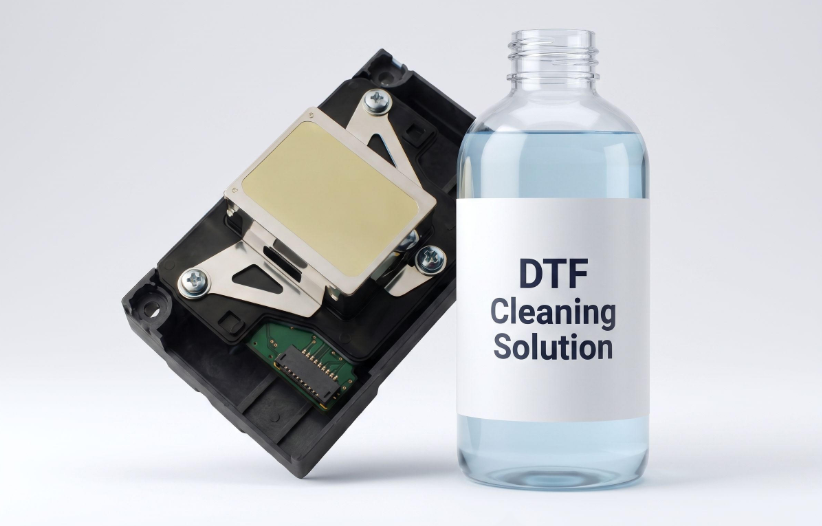
Why DIY DTF Cleaning Solution Is Not Worth the Risk (The Real Cost)
A homemade DTF cleaning solution can save you about $15 in chemicals — and cost you $350 to $1,000 in a destroyed printhead. Here's the chemistry of why forum recipes fail on DTF ink, the actual repair math, and what to use instead.
The Chemistry: Why DIY Recipes Fail with DTF Ink
Popular DIY recipes online combine common household items: distilled water, a window cleaner such as Windex, isopropyl alcohol, and a little vegetable glycerin. That mix can get a conventional aqueous desktop printer through a clean. But DTF ink is a completely different chemical system, and it punishes shortcuts.
The problem with alcohol on DTF printheads
Most DIY guides lean on isopropyl alcohol (IPA) because it evaporates fast and cuts through residue. On modern DTF printheads like the Epson XP600 and i3200, IPA does real damage:
- Drying agent: IPA strips moisture from the rubber gaskets and manifold seals inside the printhead.
- Leakage and shorting: Over time the dried seals crack, leading to ink leaks, electrical faults, or cross-channel color contamination.
- Delamination: IPA attacks the adhesive coating around the nozzle plate. Once that coating lifts, the firing chambers are finished — no fluid can bring them back.
Why DIY mixes can't handle white ink (titanium dioxide)
White ink is the hardest problem in DTF printing. To produce an opaque white layer, DTF white ink is loaded with titanium dioxide pigment. Titanium dioxide doesn't dissolve — in fresh ink it's held in suspension by dispersants. When the ink dries or the dispersant system is disrupted, the pigment settles and packs into a rock-hard deposit inside your lines and dampers.
Here's the catch: household chemicals don't restore that suspension. Worse, alcohol- and ammonia-based mixes can break the dispersant system entirely, causing the pigment to flocculate — clump together — into a sludge that's harder to remove than the original clog. Purpose-made DTF cleaning fluids use pH buffers, surfactants, and chelating agents matched to the ink chemistry to soften deposits and re-disperse the pigment without corroding printhead components.
Mineral deposits and surface tension problems
Even if you dilute with distilled water, home compounding gives you no quality control:
- Micro-crystallization: Any trace minerals crystallize near the nozzles under piezoelectric heat.
- Ink deflection: DIY mixes don't match the viscosity and surface tension of professional fluids. If you've ever seen sudden horizontal banding or line splitting on your prints, an off-spec fluid in the capping station is a common culprit.
The Math Behind the Real Cost of the DIY Risk
Scenario A: using a professional DTF cleaning solution
- Initial cost: $15–$30 for a quality, ready-to-use bottle.
- Longevity: one bottle covers 3–6 months of routine capping-station wet-caps.
- Equipment condition: no nozzle clogs, fewer head cleanings, no surprise failures.
Scenario B: the real cost of a DIY failure
One of our customers — Mark, who runs a custom apparel shop in Texas — used a homemade alcohol-glycerin mix to skip a shipping fee. Within three weeks, the fluid had destroyed the manifolds on his dual i3200 printheads.
- Replacement parts: an Epson XP600 printhead runs $250–$350 — a genuine replacement print head for HueDrift printers is $320–$360. An i3200 head runs $800–$1,000.
- Labor: if you can't swap the head yourself, expect hundreds more in service labor.
- Downtime: Mark's machine sat dead for 5 days waiting on parts. He lost a 200-shirt local school order worth over $1,800.
| Factor | Professional solution | DIY homemade mixture |
|---|---|---|
| Initial cost | $15 – $30 | ~$2 – $5 |
| Risk of printhead damage | Extremely low (formulated) | High (corrosive / ineffective) |
| Chance of downtime | Low | High |
| Total cost per year | $50 – $100 | $500 – $1,500+ (with parts) |
How to Pick a Quality Commercial DTF Cleaning Solution
Not all commercial fluids are equal. Here's what to check before you buy — the same criteria we apply to everything in our DTF supplies lineup:
- Neutral to mildly alkaline pH (7.5–8.5): strong enough to soften pigment deposits, gentle enough for seals and skin.
- Free of aggressive solvents: no high concentrations of acetone, ammonia, or other harsh solvents.
- Contains humectants: good fluids keep the capping station moist between print jobs, which is most of the battle in DTF maintenance.
A quality cleaning fluid is one piece of a bigger maintenance picture — your printer and curing oven setup matter just as much, as we cover in why your DTF printer and oven matter most.
FAQ: DTF Printhead Maintenance
Can I clean my DTF printer with Windex?
No. Never use Windex or any ammonia-based product. Ammonia corrodes the copper and aluminum components inside the printhead, and the damage is permanent.
How often should I apply DTF cleaning solution?
Daily. Use a small amount of professional cleaning solution to wipe the wiper blade and wet the capping station at the end of each print day.
Can a professional solution recover a fully clogged printhead?
Often, yes. A DIY mix usually makes a hard clog worse by drying and flocculating the titanium dioxide further, but a professional flush can break down stubborn blockages. If the head's electronics are intact, a deep soak in commercial fluid frequently restores the nozzles.
Conclusion: Protect Your Investment, Choose Professional
Your DTF printer is the engine of your business — a specialized machine built to run on precise chemical balances. Feeding it a home-brewed mix is a shortcut that almost always ends at a dead printhead, an empty production schedule, and a repair bill 20× the money you "saved."
Ready to protect your printhead?
Stock up on maintenance essentials with free US shipping, or ask our tech team what your specific printer needs — lifetime remote support comes standard with every HueDrift machine, average response under 2 hours.
🇺🇸 Free shipping within the US · 12-month warranty · Lifetime remote support