
DTF Equipment · Curing
DTF Curing Oven vs Shaker Dryer: Do You Really Need a Separate Oven? (2026)
If you've priced out a DTF system this year, you've probably hit the same dead end. Every week, our support team gets asked one question: if the powder shaker already has a built-in dryer, why does anyone sell standalone DTF curing ovens at those prices?
Here's the honest answer: for most small roll-to-roll operations, the shaker dryer is more than enough. A separate oven earns its cost in only three cases — sheet-fed workflows, high daily output, or when you need curing to run independently from printing. Let's find where your shop sits, so you don't pay for equipment you'll never switch on.
Quick Answer: When You Need a Separate Oven (and When You Don't)
- Run an A3/A3+ roll-to-roll printer with a matched shaker — like the pre-paired systems in our DTF printing equipment collection
- Produce modest volume (roughly under 100 transfers a day)
- Confirm the shaker's heat zone reaches the temperature your powder supplier specifies
- Print on cut sheets rather than rolls
- Are scaling past the point where the shaker's belt becomes the bottleneck
- Want curing decoupled from printing, so one machine's downtime doesn't stop the other
On our remote support calls, "I need an oven" often turns out to be a settings problem. One client running two roll-to-roll units was ready to order an infrared tunnel oven because his transfers felt gummy. We checked his line on a video call: the film was moving through the shaker's heat zone too fast for the tubes to keep up. One belt-speed adjustment fixed the cure — no oven required.
How DTF Curing Actually Works
Curing is controlled melting. The hot melt adhesive powder (TPU) applied by your shaker starts as loose granules. Under heat it softens, flows, and bonds to the ink layer. Get it right and the transfer survives repeated washing; get it wrong and the design cracks or peels early.
You can read cure quality with your eyes:
- Fully cured: a uniform, matte orange-peel finish across the whole print
- Under-cured: glossy spots and gritty particles — sometimes followed within a day by oily droplets sweating from the white ink layer, a sign moisture never fully evaporated
- Over-cured: yellowed film edges, brittle patches, hard plasticky adhesive
Full Cure vs Gel Cure
Not every workflow needs a complete melt. Many shops intentionally stop at a gel cure — the powder is bonded but keeps a slightly textured, grainy finish, and the heat press completes the melt during application. Gel curing suits transfers printed for storage or shipped to customers. A full cure suits garments you press immediately. Both are valid; consistency is what matters.
What a Shaker Dryer Can (and Can't) Do
A shaker dryer is the heated conveyor section built into the end of the powdering stage. For roll-to-roll production it's genuinely efficient — film is powdered, shaken, and cured in one continuous pass with no handling in between. Dialing in the belt speed correctly is the critical step; our step-by-step printer and shaker setup guide covers how to sync it with your printer.
Its limits are structural, not a quality flaw:
- Speed is chained to the printer. Film moves at print speed, so dwell time in the heat zone is fixed.
- Roll film only. Cut sheets can't ride the conveyor reliably.
- Single point of failure. If the heating module fails, the whole line stops with it.
Standalone DTF Curing Ovens: Three Types
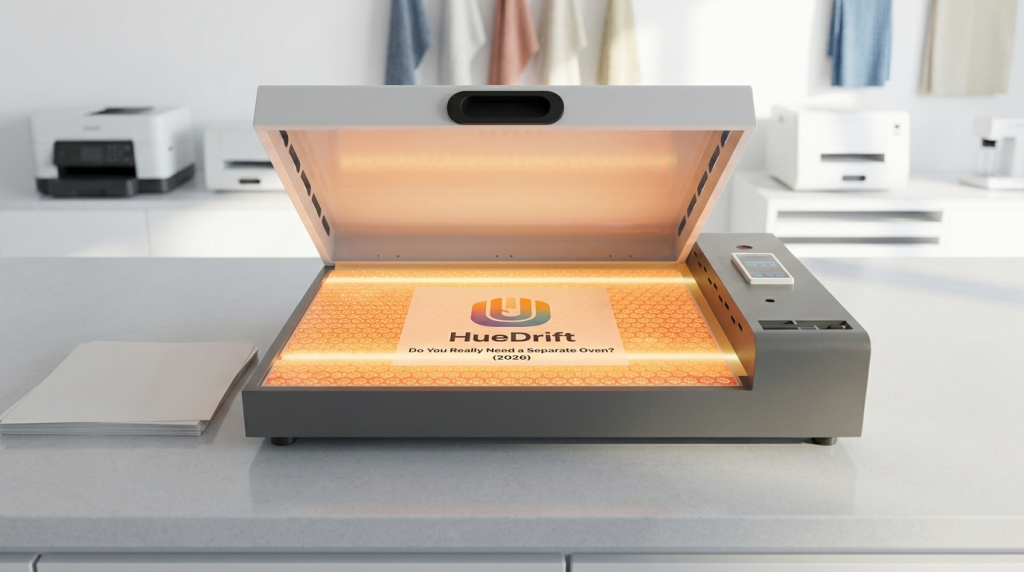
Drawer-Style Curing Ovens
A sliding-drawer oven for curing individual film sheets. Ideal for sampling, small batches, and sheet-fed desktop setups. If this matches your workflow, our upgraded DTF curing oven is built exactly for this use case — even heat distribution for A3-class film sheets.
Conveyor and Infrared Tunnel Ovens
Built for volume. Curing runs on its own belt at its own pace, fully independent of the printer — this is what "decoupling" means in practice. Expect to budget for floor space, higher power draw, and dedicated ventilation.
Heat Press Hover Method
Holding the press just above the printed film can cure a transfer in a pinch. Treat it strictly as an emergency technique: plate heat is uneven and throughput is painfully slow.
Head-to-Head Comparison: Shaker Dryer vs Curing Oven
| Factor | Built-in Shaker Dryer | Standalone Curing Oven |
|---|---|---|
| Workflow | Continuous roll-to-roll | Cut sheets or offline rolls |
| Throughput | Tied to print speed | Independently controlled |
| Footprint | No extra floor space | Extra floor space required |
| Upfront cost | Included with the shaker | Separate investment |
| Downtime risk | Heater failure stops the line | Isolated from the printer |
Temperature and Time: Follow the Powder, Not the Forums
Every TPU powder formulation has its own curing window, and the ranges differ meaningfully between suppliers. The spec sheet from your powder supplier beats any number you read online — including this article. Be aware that inexpensive oven thermometers can read noticeably off; verify the actual surface temperature before you trust a setting.
Two environmental factors quietly sabotage curing:
- Humidity — moist TPU powder clumps in the hopper and cures unevenly. Store opened powder sealed with silica gel.
- Belt speed drift — a faster belt means less dwell time in the heat zone, which equals instant under-curing.
Is a Separate Oven Worth the Money?
Do the math on daily throughput, not the feature list:
- Under ~30 transfers/day: an oven is an idle asset. Skip it for now.
- Growing roll-to-roll volume: upgrade the shaker or printhead first — that's usually the real bottleneck.
- Sheet workflow or 100+ transfers/day: an oven becomes a capacity investment that pays back through parallel curing and printing.
Before committing either way, run your volume through our free DTF Printer ROI Calculator to see how the numbers land for your shop.
FAQ
Can a shaker dryer replace a curing oven?
For roll-to-roll workflows at small-to-mid volume, yes — provided the temperature and belt speed are set correctly for your powder.
What temperature does DTF powder cure at?
It depends on the formulation. Always follow your powder supplier's spec sheet, then confirm with a test print showing an even matte finish.
Can I cure DTF transfers with a heat press?
Yes, using the hover method — but only for emergencies or quick tests. It's too slow and uneven for production work.
How do I know a transfer is fully cured?
Look for a uniform matte, orange-peel finish with no glossy spots, then confirm with at least three wash tests on a scrap garment.
Is under-curing or over-curing worse?
They fail differently: under-cured transfers wash off; over-cured transfers turn brittle, yellow, and crack. Aim for the supplier's recommended window.
Final Verdict
A separate DTF curing oven isn't an upgrade every shop needs — it's a workflow decision. Roll-to-roll with modest volume? Your shaker dryer already does the job. Printing sheets, scaling output, or protecting uptime? That's when a standalone oven earns its floor space.
Still choosing your setup?
Start with our complete buyer's guide, or get a bundle matched to your daily volume from our team.
✓ Free US shipping ✓ 12-month warranty ✓ Lifetime remote support