DTF Costs & Buying Decisions
DTF Starter Kit vs. Buying Everything Separately: Which Saves You More?
Here's the short answer: a DTF starter kit costs less than buying the same supplies as separate retail orders — and the gap widens once shipping and compatibility mistakes are counted. The kit stops being the best deal only when you're reordering consumables more than about once a month; at that point, volume pricing from your supplier beats any retail option. This guide puts numbers on both sides so you can see exactly where you fall.
New to DTF and not sure what a kit should even contain? Start with our guide on what makes a good DTF printer starter kit — this article assumes you know the components and only asks which way of buying them is cheaper.
The Itemized Price Test: Kit vs. Cart
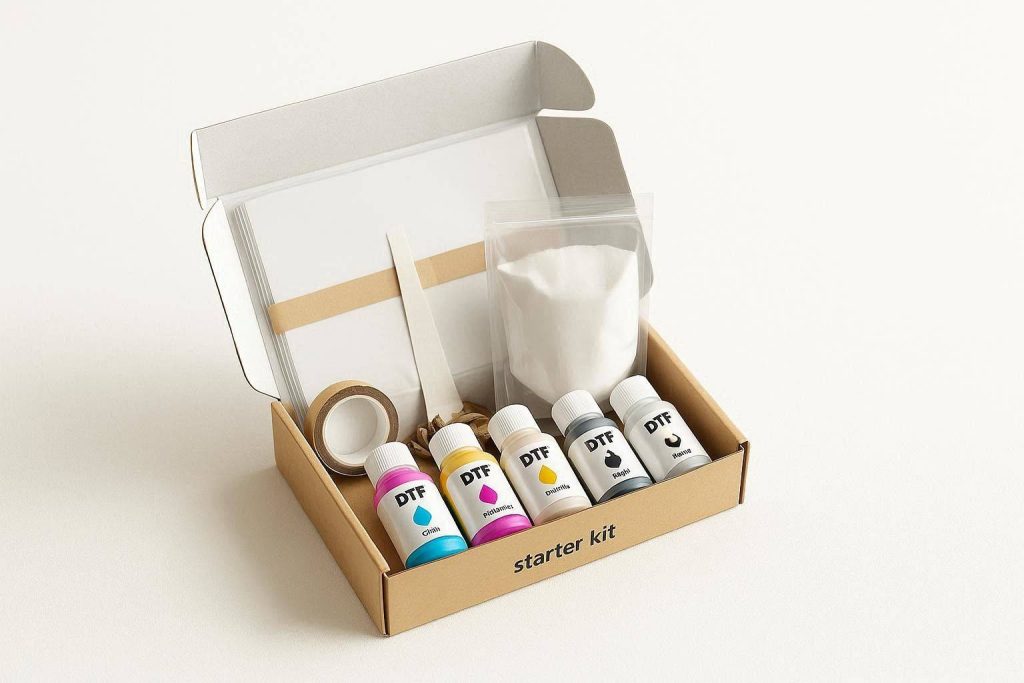
We compared the four core consumables the way a beginner would actually buy them — one item at a time from separate retail listings — against typical all-in-one consumable kits on the market:
| Item | Bought Separately | Market Consumable Kits |
|---|---|---|
| DTF film, 100 A4 sheets | $20–$40 | included |
| Adhesive powder, 500 g | $15–$25 | included |
| DTF ink set (CMYK + White) | $50–$90 | included |
| Heat tape & small accessories | $10–$20 | included |
| Total | $95–$175 | ~$10–$150 |
Entry-level consumable kits from established brands commonly sell between roughly $10 and $150 — frequently below the combined retail price of their own contents. Two reasons the math works this way:
- Kits are customer-acquisition products. A kit buyer becomes a repeat consumables customer, so suppliers can afford to discount the first box.
- Shipping multiplies quietly. Three to five separate orders commonly add $15–$40 in freight. A kit ships as one box, often free.
The one line item that changes the math: RIP software. Bought alone, a license runs $100–$300. Complete printer bundles include it — our own printers ship with the RIP software dongle, initial CMYK+White ink, powder, and film, a supplies package worth over $500. If your DIY route requires buying a license separately, the "cheap" cart just doubled.
First-Month Cost: Three Real Scenarios
Totals only matter against what you'll actually print. Here's the first-month math at three volumes:
Hobbyist ~20 prints/mo
One consumable kit covers the month with film to spare. Buying separately means paying shipping on items you'll barely dent. Kit wins, and it isn't close.
Side hustle ~100 prints/mo
You'll finish a 100-sheet kit within the month. One kit plus a film top-up still beats assembling the same cart from separate listings, mainly on shipping and the ink-set discount. Kit wins on cost; buying separately only makes sense if you're topping up leftovers from a previous kit.
Shop 500+ prints/mo
At this volume, retail pricing of any kind — kits or single items — is no longer the right question. Supply consistency and per-unit cost matter more, and both come from ordering in volume directly from your supplier. Most manufacturers, including us, quote bulk consumable orders — see our bulk purchasing program for volume pricing.
Finding Your Switch Point
You don't need a spreadsheet to know when you've outgrown kits — your reorder frequency tells you:
- A 100-sheet consumable kit yields roughly 80–100 standard transfers, so kit cost ÷ prints gives your per-print supply cost.
- Reordering less than once a month? Stay with kits. The bundle discount, single shipment, and zero mismatch risk are worth more than any marginal saving.
- Placing a second or third consumables order in the same month? That's the signal. You now have the volume to negotiate supplier pricing that no retail kit matches.
Want to run the same math with equipment costs included? Our DTF printer ROI calculator projects your break-even timeline from your actual order volume.
What the Sticker Price Doesn't Show
Two cost items never appear at checkout but decide many beginners' real totals:
- The cost of one mismatch. A bottle of white ink that clogs your printhead, or powder that won't bond to your film brand, is $20–$90 of product in the trash plus reprint materials. Kits eliminate this failure mode by pre-matching components; a DIY cart carries the risk on every line item.
- Restock pricing after the kit. Kit pricing applies once. Compare your supplier's refill prices before committing, because that's what you'll actually pay from month two onward.
Verdict: Run the Numbers, Then Don't Overthink It
- Starting out or printing under a few hundred pieces a month → buy the DTF starter kit. Bundle discount, one shipment, zero compatibility gambles.
- Reordering supplies more than monthly → skip retail entirely. Contact your supplier about volume pricing.
- Already own a printer or partial supplies → buy only what's missing. A kit would make you pay twice for what you have.
Ready to compare complete setups instead of just consumables? See our picks for the best DTF printer and oven bundles for small business — with side-by-side pricing for three tiers.
FAQ — The Cost Questions
How much does DTF printing cost per shirt?
Based on our testing of 12 DTF ink brands, materials run $0.09–$0.19 per square inch — ink $0.05–$0.10, film $0.03–$0.07, powder $0.01–$0.02. That's roughly $1–$2 for a small chest logo and $10–$20 for a full-front design. See the full formula in our DTF price calculator and cost breakdown.
Is it cheaper to buy DTF film in rolls or sheets?
Per print, rolls cost less — but only with roll-feed equipment and enough volume to use a roll before it ages. For cut-sheet desktop workflows under a few hundred prints monthly, sheets waste less.
Do DTF starter kits actually save money, or is it marketing?
Both, honestly. Kits genuinely price below the sum of their parts — and that discount is also strategic, because suppliers want your refill business afterward. Take the discount; just compare refill prices too.
When should I stop buying starter kits?
When you're placing consumable orders more than about once a month. At that cadence, you have the volume to ask your supplier for bulk pricing that no retail kit matches.