
Table of Contents
ToggleWhy Temperature Consistency Makes or Breaks Your DTF Curing Results
Ceramic heating elements naturally shut themselves off around 120–130°C by default, below the 150–160°C most DTF curing needs — curing-grade equipment has to use a specially tuned version, and even then, good airflow design still determines whether that heat actually reaches the print evenly.
Pull a print from the curing oven with patchy adhesion — solid in the middle, still tacky at the edges — and most people start troubleshooting belt speed or airflow. Those matter, but there’s a more basic question worth asking first: is the heating element inside your oven actually built for the temperature DTF curing needs?
A Surprising Mismatch Most Buyers Never Check
DTF powder curing usually needs a stable 150–160°C. Here’s the catch: the ceramic heating material used in most self-regulating heaters naturally shuts itself down around 120–130°C — that’s just where the raw material’s built-in cutoff sits by default. If a curing oven maker just grabbed an off-the-shelf ceramic element without adjusting for this, its automatic shutoff point would sit below your actual curing target, which completely defeats the purpose.
Good curing equipment uses a version of the ceramic that’s been deliberately tweaked — through changes to its exact chemical recipe — to push that shutoff point higher, right around where DTF curing actually needs it. This is a real engineering decision manufacturers have to get right, not something that comes for free just because a spec sheet says “PTC heating.”
How the Self-Shutoff Actually Works
Picture the ceramic as made of countless tiny conductive grains glued together, with electricity having to cross the thin boundary between each grain — like passing through a huge number of tiny gates. Below its target temperature, those gates sit open and current flows easily. Cross that temperature, and something shifts in the material’s structure — the gates slam almost shut within a few degrees, resistance jumps by a massive factor, and since less resistance means way more current gets through, less resistance the opposite way means the heat output collapses almost as fast as the resistance climbed. No sensor, no external thermostat — the material does this on its own.
Why a Good Element Still Isn’t the Whole Story
Here’s the part curing equipment buyers often miss: getting the shutoff temperature right sets an upper limit, but the actual air temperature hitting your print also depends on how well the equipment moves heat from the element into the airstream — good duct design, fan placement, even spacing across the heating bank. A perfectly good heating element sitting in a poorly designed airflow path can still produce uneven curing, which is the belt-speed-and-airflow layer of the problem sitting on top of the element choice, not instead of it.
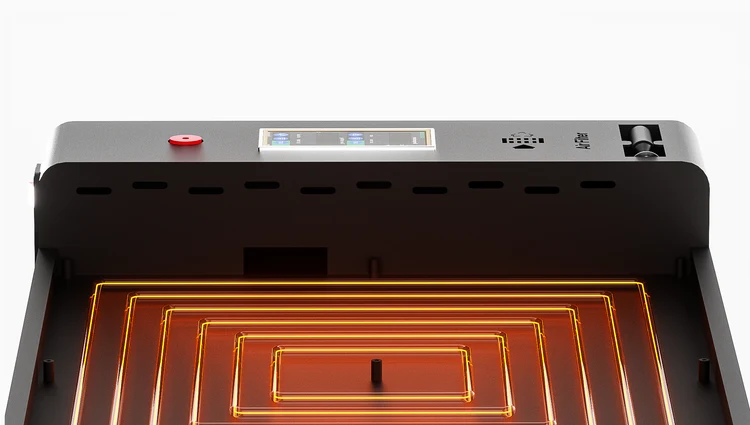
PTCWORKS’ air heater lineup shows the range of forced-air modules built for exactly this kind of application, with Curie points tuned to different target ranges rather than one generic setting.
What to Actually Ask Equipment Manufacturers
- What’s the element’s built-in shutoff temperature, and does it sit comfortably above your curing target with room to spare?
- Is airflow tested for evenness across the whole heating bank, or just assumed to be fine?
- What’s the actual temperature swing under real load, not just at idle?
For manufacturers building or upgrading curing equipment, suppliers like PTCWORKS build heating elements tuned to specific temperature targets rather than a one-size-fits-all part.
Your press settings only matter as much as the physics behind them actually supports — check the shutoff temperature and the airflow design before you start fiddling with belt speed.
Frequently Asked Questions
Why can’t any random ceramic heater be used for DTF curing?
The standard version of this ceramic material naturally shuts off around 120–130°C, which is below the 150–160°C most DTF curing actually needs. Equipment built for curing has to use a version specifically tuned to shut off higher.
Why does temperature steadiness matter so much for curing specifically?
Curing is very sensitive to getting the exact right temperature consistently — even brief dips caused by a lagging thermostat can leave a noticeably different result than a material that holds a tight, steady band on its own.
If the heating element is right, why is curing still sometimes uneven?
The element sets an upper limit on temperature, but how well that heat actually reaches the print depends on airflow — duct design and fan placement matter just as much as the heating element choice itself.